

How to Prune Hydrangeas the right way – Types to prune and How to avoid losing blooms.
Hydrangeas are one of the most widely planted flowering shrubs across New Jersey landscapes, valued for their large blooms, long flowering season, and versatility in both foundation and garden bed plantings.
Despite their popularity, hydrangea pruning is often misunderstood.
Improper timing or technique can reduce or eliminate flowering for the entire season. Understanding how and when to prune is essential to maintaining plant health, structure, and consistent bloom performance.
This guide outlines the correct approach to spring hydrangea pruning, including plant identification, timing, and step-by-step technique – leaving you knowing how to prune hydrangeas the right way.

FAQ: Spring Hydrangea Pruning
No. Only panicle and smooth hydrangeas should be pruned aggressively in spring.
Bigleaf, oakleaf, and mountain hydrangeas should only be lightly cleaned up at that time.
For new-wood varieties, early pruning is generally safe.
For old-wood varieties, pruning too early can remove developing flower buds and prevent blooming.
For new-wood hydrangeas, stems can be reduced by:
- up to ⅓ of their height, depending on desired size and shape
For old-wood types, limit cuts to:
- dead wood removal
- light shaping only
Common causes may include:
- pruning at the wrong time
- cutting off old wood
- winter damage
- insufficient sunlight
Improper pruning is one of the most frequent reasons for reduced blooming.
Use: Sharp hand pruners for most cuts & Loppers for thicker stems
Clean tools between plants to prevent disease spread.
Identify Your Hydrangea Type
Pruning requirements vary significantly depending on the hydrangea species.
The key distinction is whether the plant blooms on new wood (current season growth) or old wood (previous season growth).
Hydrangeas That Can Be Pruned in Spring
These varieties bloom on new wood and respond well to early-season pruning:
- Panicle Hydrangea (Hydrangea paniculata)
Common varieties: Limelight, Bobo, Vanilla Strawberry - Smooth Hydrangea (Hydrangea arborescens)
Common varieties: Annabelle, Incrediball
These types can be pruned in late winter or early spring without negatively impacting flowering.
Hydrangeas That Should Not Be Heavily Pruned in Spring
These varieties bloom on old wood:
- Bigleaf Hydrangea (Hydrangea macrophylla)
- Oakleaf Hydrangea (Hydrangea quercifolia)
- Mountain Hydrangea (Hydrangea serrata)
Heavy spring pruning will remove established flower buds and significantly reduce bloom production.
For these types, limit spring pruning to the removal of dead or damaged wood only.
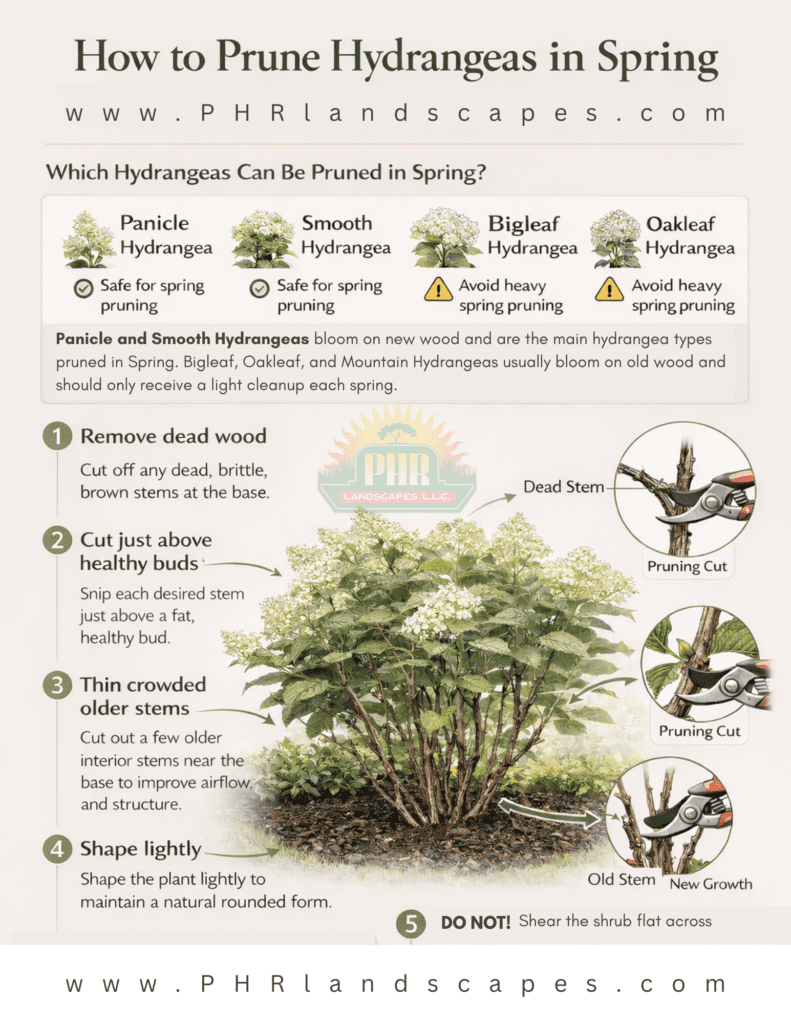
How to Prune Hydrangeas in Spring: A Visual Guide
When to Prune Hydrangeas in New Jersey
Timing should align with both plant type and seasonal conditions.
For new-wood hydrangeas:
- Prune in late winter to early spring
- In New Jersey: typically late March through early April
For old-wood hydrangeas:
- Perform only light cleanup pruning in spring
- Schedule structural pruning after flowering
Pruning before active growth begins allows the plant to direct energy into new shoots and flowers.
Hydrangea Pruning: Step-By-Step
Step 1: Remove Dead or Damaged Wood
Identify and remove:
- brown, brittle stems
- stems without visible buds
- winter-damaged branches
Cut back to:
- the base of the plant, or
- the nearest healthy growth point
This step improves plant health and prevents wasted energy on non-viable growth.
Step 2: Cut Above Healthy Buds
Locate:
- visible buds or nodes along each stem
Make cuts:
- approximately ¼ inch above a healthy bud
- at a slight angle
This encourages controlled branching and new growth development.
Step 3: Thin Out Older or Crowded Stems
Remove select:
- older, woody stems at the base
- interior growth restricting airflow
This improves:
- air circulation
- light penetration
- overall plant structure
Avoid removing more than 25-30% of the plant at one time.
Step 4: Shape for Natural Form
After structural pruning, refine the plant’s shape:
- maintain a rounded, balanced structure
- preserve evenly spaced stems
- avoid over-reduction
Hydrangeas perform best when allowed to retain their natural growth habit.
Step 5: Avoid Shearing
Do not:
- shear hydrangeas flat across the top
- prune them like formal hedges
Shearing leads to:
- weak stem development
- uneven growth
- reduced flowering
Hydrangeas should always be selectively pruned.
Common Hydrangea Pruning Mistakes
Pruning at the wrong time – Spring pruning of old-wood varieties removes flower buds.
Over-pruning – Excessive cutting can reduce bloom production and stress the plant.
Incorrect plant identification – Applying the same pruning method to all hydrangeas leads to inconsistent results.
Cutting below viable buds – Improper cuts reduce regrowth potential and weaken structure.
Best Practices for Long-Term Hydrangea Health
- Use clean, sharp pruning tools
- Maintain consistent soil moisture
- Apply mulch to regulate temperature and moisture
- Avoid excessive fertilization
- Allow adequate spacing for mature growth
Proper maintenance supports both structural integrity and seasonal performance.
How Pruning Affects Flowering
- New wood hydrangeas → bloom on current season growth → safe for spring pruning
- Old wood hydrangeas → bloom on prior season growth → require post-bloom pruning
Understanding this distinction is critical for maintaining consistent flowering year to year.
The Better Landscaping Company in Westfield, Fanwood, & Scotch Plains NJ
Hydrangea pruning is not complicated, but it does require precision.
Correct timing, proper technique, and accurate plant identification are the primary factors that determine whether a hydrangea produces strong, consistent blooms.
When maintained correctly, hydrangeas remain one of the most reliable and visually impactful shrubs in New Jersey landscapes.
Maintaining a manicured landscape starts with consistent, professional care – and that’s where we come in!
💡 If you’re looking for a dependable, experienced landscaping services in Scotch Plains, Fanwood, Westfield, and Surrounding Areas, we’re here to help.
👉 Call PHR Today to Schedule Your Free Consultation
👉 Landscape Design in Westfield, Fanwood, Scotch Plains and Surrounding Areas
Share This Post with Friends & Colleagues

Follow us on Facebook @PHRLandscapes
Phone: (908) 322-6500
Email: sales@phrlandscapes.com
1590 E. 2nd Street, Scotch Plains, NJ 07076

