

Learn how to identify common lawn weeds in NJ, what they reveal about your yard, and how to properly remove and prevent them.
A few weeds in the lawn may not seem like a major problem at first; One dandelion shows up near the walkway. A patch of clover appears in the backyard. A few crabgrass blades spread along the driveway. Then, by the middle of summer, the lawn starts looking less like grass and more like a mix of whatever decided to grow there.
For many New Jersey homeowners, weeds are not just an appearance issue. They are a sign that the lawn is giving certain plants an opportunity.
Weeds usually move into areas where the turf is thin, stressed, compacted, cut too short, poorly drained, underfed, overwatered, or struggling to compete. The specific weed matters because different weeds point to different lawn problems.
Crabgrass does not behave like clover. Clover does not behave like nutsedge. Nutsedge is not even a true grass. Dandelions and plantain may both be broadleaf weeds, but they often tell a different story about the soil and lawn conditions.
That is why the best weed control strategy is not simply “spray what you see.”
A healthier approach starts with identifying the weed, understanding why it is there, removing or controlling it properly, and improving the lawn conditions that allowed it to spread in the first place.
Rutgers Cooperative Extension emphasizes that good mowing, soil management, turfgrass selection, and prompt weed identification all play an important role in maintaining a healthy lawn; hand pulling can help with some weeds, but the underlying soil or cultural issue also needs to be addressed.

Quick Answer: What Are the Most Common Lawn Weeds in NJ?
Five common lawn weeds New Jersey homeowners often notice are:
- Crabgrass
- White clover
- Dandelion
- Yellow nutsedge
- Broadleaf plantain
These are not the only weeds that grow in New Jersey lawns, but they are some of the most recognizable and useful for understanding what may be happening in the yard.
Rutgers maintains a New Jersey Weed Gallery for identifying weeds found across the state, and Rutgers lawn weed resources commonly discuss broadleaf weeds such as dandelion, white clover, and plantain, as well as grassy and sedge-type weeds such as crabgrass and yellow nutsedge.
Why Those Pesky Lawn Weeds Keep Coming Back
Weeds are opportunists, they take advantage of conditions where grass is weak or missing.
- Bare soil
- Thin turf
- Mowing too short
- Compacted soil
- Poor drainage
- Low fertility
- Drought stress
- Overwatering
- Too much shade
- Heavy foot traffic
- Poor grass selection
- Weak lawn establishment
- Seed washout after storms
A lawn that is dense, properly mowed, and growing in healthy soil gives weeds fewer openings. Rutgers organic land-care guidance recommends mowing lawns high enough to shade the soil surface and help reduce weed-seed germination. Rutgers lawn-care guidance also recommends mowing frequently enough that no more than one-third of the grass blade is removed at one time.
That does not mean mowing alone will solve every weed problem. But it does show why long-term weed control depends on the condition of the lawn, not only what is applied to the weeds.
1. Crabgrass
Crabgrass is one of the most common and frustrating summer lawn weeds in New Jersey.
It is a warm-season annual grassy weed, meaning it germinates from seed, grows aggressively during warm weather, produces more seed, and dies off when cold weather arrives. The problem is that each season can leave behind more seed for the following year.
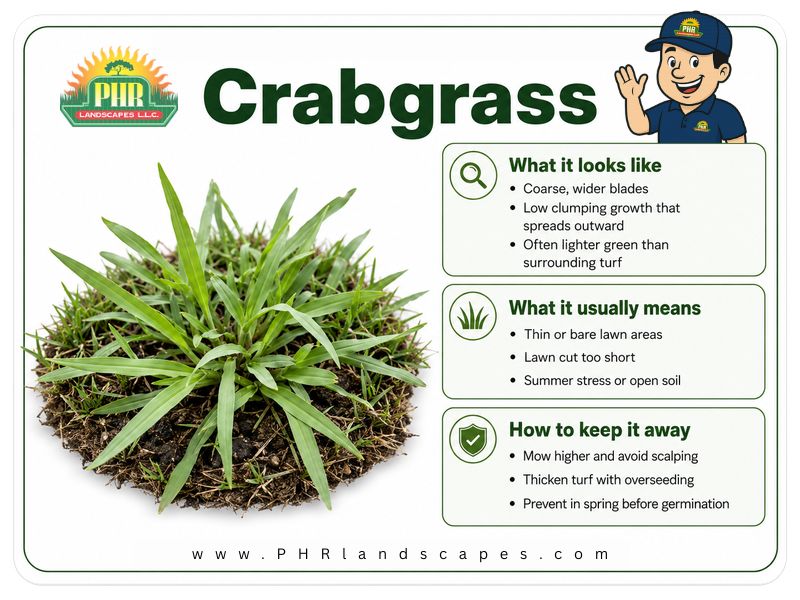
What Crabgrass Looks Like
Crabgrass often grows in a spreading, low, clumpy pattern. Its blades are wider and coarser than desirable cool-season lawn grasses. It may appear lighter green than the surrounding turf and can spread outward from a central point.
By late summer, crabgrass can make a lawn look rough, uneven, and overrun.
What Crabgrass Means For Your Lawn
Crabgrass usually means the lawn had open space available when crabgrass seeds germinated.
It does not necessarily mean the homeowner did something wrong. It may mean the lawn was thin after winter, weakened by drought, cut too low, damaged by traffic, or not dense enough to shade the soil when warm-season weeds started growing.
Rutgers notes that crabgrass control depends heavily on timing because preemergence materials are used before crabgrass becomes established, while some products can control crabgrass shortly after germination depending on the active ingredient and timing.
How to Get Rid of Crabgrass
For a few isolated plants, crabgrass can sometimes be pulled by hand before it produces seed. This is easiest when the soil is slightly moist and the plant is still young.
For heavier crabgrass infestations, control usually depends on timing:
- Early spring: prevent crabgrass before it germinates.
- Late spring / early summer: young crabgrass may still be manageable with the right approach.
- Late summer: mature crabgrass is more difficult to control and may already be producing seed.
- Fall: focus on rebuilding desirable turf so crabgrass has fewer openings next year.
A common mistake is waiting until crabgrass is large, obvious, and spreading across the lawn before taking action. By that point, the better long-term strategy may be to renovate thin areas in late summer or early fall and plan prevention for the following spring.
How to Keep Crabgrass Away
Crabgrass prevention is less about chasing every individual plant and more about building a denser lawn.
Helpful steps include:
- Mow at the proper height
- Avoid scalping the lawn
- Fill bare spots before summer
- Improve thin turf through overseeding
- Correct compacted soil
- Water deeply when needed instead of shallow daily watering
- Repair lawn edges along driveways and walkways
- Use spring preemergent control when appropriate
- Renovate severely thin areas during the fall seeding window
If the lawn is mostly crabgrass by the end of summer, it may be a sign that the area needs more than weed control. Lawn renovation, topsoil, grading, seeding, or sod may be needed to rebuild the turf.
2. White Clover
White clover is one of the most familiar lawn weeds in New Jersey.
It has rounded leaflets, a low-growing habit, and small white flowers that attract bees. Some homeowners do not mind clover, especially in low-maintenance or pollinator-friendly lawns. Others dislike it because it creates uneven texture, spreads into patches, and makes the lawn look less uniform.
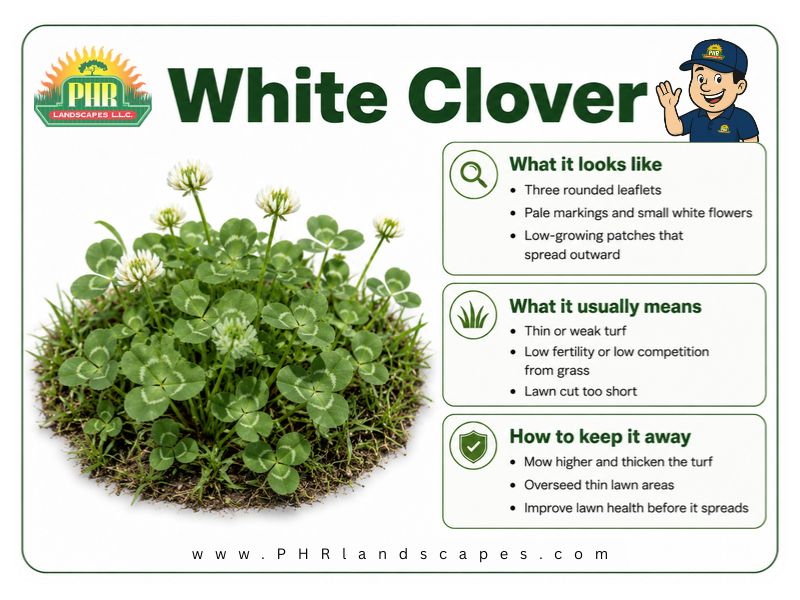
What White Clover Looks Like
White clover has three leaflets, often with pale markings. It grows low to the ground and spreads through creeping stems. Its white flowers rise slightly above the foliage.
It commonly appears in:
- Thin lawns
- Low-fertility areas
- Lawns cut too short
- Dry or stressed turf
- Open patches where grass is not competing strongly
- Areas where soil nitrogen may be low
Rutgers’ broadleaf weed guidance includes white clover among common trifoliate lawn weeds and broadleaf weeds found in cool-season turf.
What Clover Means For Your Lawn
Clover can indicate that the grass is not dense or competitive enough.
It may also point to low nitrogen fertility because clover can fix nitrogen through a relationship with bacteria in its roots. That does not mean every lawn with clover automatically needs fertilizer, but it does mean the turf may not be vigorous enough to outcompete it.
Clover also tolerates close mowing well. When grass is repeatedly cut too short, clover may have an advantage because it can stay low and continue spreading.
How to Get Rid of Clover
Small clover patches can sometimes be hand-pulled, though the creeping stems can make complete removal difficult.
For larger patches, proper control depends on the homeowner’s goals. Some homeowners choose to tolerate clover in certain areas. Others may use selective broadleaf weed control where appropriate, following product labels and local requirements.
A lawn-care or landscape professional can also help determine whether clover is only a surface problem or part of a larger lawn-health issue.
How to Keep Clover Away
Long-term clover prevention focuses on improving turf density.
Helpful steps include:
- Mow higher so grass can shade the soil
- Avoid scalping
- Improve thin areas with overseeding
- Use the right grass seed for the site
- Test the soil before making fertility decisions
- Correct compaction
- Reduce repeated stress from foot traffic
- Keep landscape beds and lawn edges defined
Clover often becomes less noticeable when the surrounding turf becomes thicker and healthier.
3. Dandelion
Dandelions are easy to recognize, but they are not always easy to eliminate.
They produce bright yellow flowers, followed by white puffball seed heads that spread easily in the wind. Beneath the surface, they develop a long taproot that helps the plant survive mowing and regrow after partial removal.
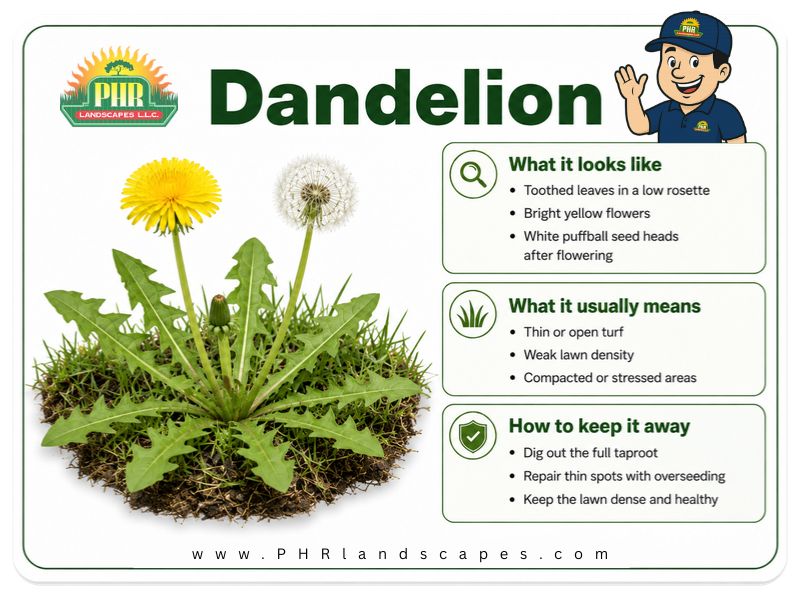
What Dandelions Look Like
Dandelions form a low rosette of leaves. The leaves are deeply toothed, and the yellow flower grows on a hollow stalk. After flowering, the plant produces a round white seed head.
They often appear in:
- Thin lawns
- Open soil
- Lawn edges
- Compacted areas
- Neglected or underperforming turf
- Areas where grass coverage is inconsistent
Rutgers broadleaf weed resources use dandelion as a common example of broadleaf weed growth in thin lawn canopies.
What Dandelions Mean For Your Lawn
Dandelions usually mean the lawn has enough openings for seeds to germinate and survive.
They can grow in a variety of conditions, so they do not point to one single problem. But they often become more common where the lawn is thin, compacted, stressed, or not dense enough to shade the soil.
Dandelions also tell homeowners something important about timing: once flowers turn into seed heads, the weed problem can spread well beyond the original plant.
How to Get Rid of Dandelions
For isolated dandelions, digging can work if enough of the taproot is removed. Pulling off the leaves without removing the root often allows the plant to regrow.
The best time to remove dandelions by hand is when the soil is moist and the root is easier to loosen. A weeding tool can help reach deeper into the soil.
For widespread dandelions, selective broadleaf weed control may be considered where appropriate. Rutgers guidance emphasizes accurate weed identification and control before difficult weeds spread throughout the lawn.
How to Keep Dandelions Away
The best long-term strategy is to reduce open spaces where dandelion seeds can establish.
Helpful steps include:
- Mow at the correct height
- Avoid cutting the lawn too short
- Remove dandelions before they go to seed
- Overseed thin areas
- Improve compacted soil
- Keep lawn edges clean
- Repair bare spots quickly
- Maintain a dense lawn canopy
A lawn with good turf coverage will not prevent every dandelion seed from landing, but it makes it harder for those seeds to grow into mature plants.
4. Yellow Nutsedge
Yellow nutsedge is one of the most commonly misunderstood lawn weeds because many homeowners mistake it for grass.
It is not a true grass. It is a sedge, and that matters because sedges often require different control strategies than grassy or broadleaf weeds.
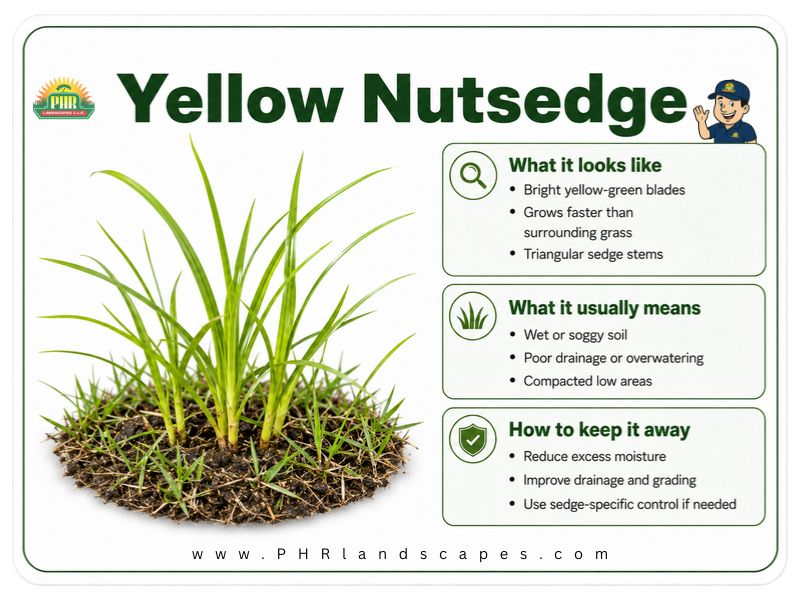
What Yellow Nutsedge Looks Like
Yellow nutsedge grows faster than surrounding turf and often sticks up above the lawn shortly after mowing. It has a yellow-green color and shiny, grass-like leaves.
One of the classic identification clues is the stem. Sedges are often described as having triangular stems, while grasses generally have round or flattened stems. Penn State Extension notes that yellow nutsedge can be identified by its triangular stem cross-section, shiny yellow-green foliage, and underground reproductive structures.
Yellow nutsedge commonly appears in:
- Wet lawn areas
- Poorly drained soil
- Overwatered lawns
- Low spots
- Irrigation problem areas
- Areas with compacted or saturated soil
Rutgers notes that yellow nutsedge is the perennial sedge commonly found in New Jersey lawns and landscapes and is more difficult to control than annual sedges.
What Yellow Nutsedge Means For Your Lawn
Yellow nutsedge often points to excess moisture.
That may come from poor drainage, compacted soil, overwatering, irrigation leaks, low spots, or soil conditions that stay wet after storms. It can also appear in disturbed soil.
If nutsedge is thriving in one part of the yard, the weed itself may not be the only issue. The lawn may be telling you that the area is staying too wet for healthy turf to compete.
How to Get Rid of Yellow Nutsedge Weeds
Yellow nutsedge should not be treated like ordinary grass.
Repeated mowing alone will not solve the problem. Pulling can work only when there are very few young plants and removal happens early, before underground tubers become established. Once tubers are present, broken or missed underground structures can allow the weed to return.
For larger infestations, sedge-specific control may be needed. Standard broadleaf or crabgrass products may not work because nutsedge belongs to a different plant group.
Because herbicide labels, timing, and turf safety matter, homeowners should follow product instructions carefully or work with a qualified lawn-care professional.
How to Keep Yellow Nutsedge Weeds Away
Long-term nutsedge management starts by asking why the area is wet.
Helpful steps include:
- Check irrigation coverage and timing
- Look for leaking sprinkler heads or lines
- Correct low spots
- Improve drainage
- Avoid overwatering
- Reduce compaction
- Regrade soggy areas when needed
- Improve turf density after the moisture issue is corrected
If the soil stays wet, nutsedge may keep returning even after treatment.
5. Broadleaf Plantain
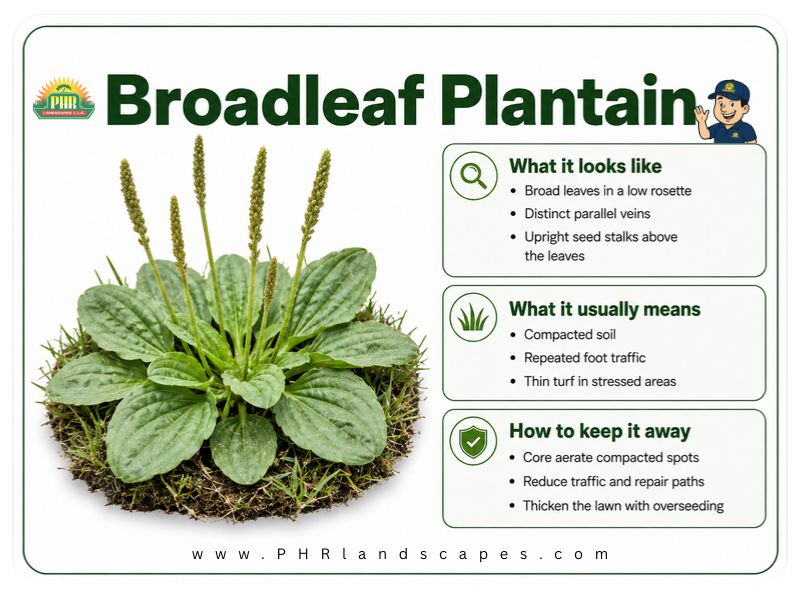
Broadleaf plantain is a tough, low-growing weed that often appears in compacted or heavily used lawn areas. It is not as visually dramatic as dandelion or as aggressive-looking as crabgrass, but it can quietly spread across thin lawns and high-traffic areas.
What Broadleaf Plantain Looks Like
Broadleaf plantain grows as a flat rosette of wide leaves. The leaves have noticeable veins running from the base to the tip. It produces seed stalks that rise above the leaves.
It commonly appears in:
- Compacted soil
- Foot-traffic areas
- Thin turf
- Poorly growing lawn sections
- Driveway and walkway edges
- Play areas
- Areas where grass struggles to root deeply
Rutgers’ New Jersey Weed Gallery includes broadleaf plantain among weeds found in the state, and Rutgers broadleaf weed guidance identifies plantains as part of the cool-season lawn weed conversation.
What Broadleaf Plantain Means For Your Lawn
Plantain often means the soil is compacted or the lawn is under stress.
This weed can tolerate conditions where desirable turf struggles. If plantain is showing up along a walkway, in a path across the lawn, or in a play area, it may be a clue that foot traffic and compaction are weakening the grass.
Plantain is also a reminder that weeds can be symptoms of physical lawn conditions, not just seed problems.
How to Get Rid of Plantain Weeds
Small plantain plants can be dug out by hand, especially when the soil is moist. Removing the crown and root system is important because partial removal may allow regrowth.
For widespread plantain, selective broadleaf weed control may be considered where appropriate. However, if the soil remains compacted, the weed pressure may continue.
How to Keep Plantain Weeds Away
Preventing plantain means improving the conditions where grass is struggling.
Helpful steps include:
- Core aerate compacted lawn areas
- Redirect repeated foot traffic
- Repair bare paths
- Improve soil conditions
- Overseed thin turf
- Maintain proper mowing height
- Add stepping stones or walkways where people naturally cut across the lawn
- Consider lawn renovation where compaction and bare spots are severe
If plantain is concentrated where people walk, the solution may not be “more weed control.” It may be a better path, walkway, or lawn layout.
The Bigger Lesson: Weeds Tell a Story About Your Lawn
Each weed gives a clue.
Crabgrass often points to thin turf, bare soil, and summer lawn stress.
Clover can point to low competition from grass, close mowing, or fertility imbalance.
Dandelions often reveal open spaces and weak turf density.
Yellow nutsedge often suggests wet soil, overwatering, or poor drainage.
Plantain frequently points to compaction and traffic stress.
This is why the same weed-control approach does not work for every yard.
A lawn filled with crabgrass may need fall seeding and spring prevention. A lawn with nutsedge may need drainage correction. A lawn with plantain may need aeration and traffic management. A lawn with clover may need thicker turf and better soil support.
The weed is the visible problem. The lawn condition is often the reason it keeps returning.
General Steps to Properly Get Rid of Weeds
A good weed-control plan usually follows four steps.
1. Identify the weed correctly
Before treating anything, know what it is.
A grassy weed, broadleaf weed, and sedge may require different management strategies. Misidentifying nutsedge as crabgrass or clover as another broadleaf weed can lead to wasted effort.
2. Remove or control the existing weed
Depending on the weed and the size of the problem, control may include:
- Hand pulling
- Digging out roots
- Removing plants before seed production
- Spot treatment where appropriate
- Broadleaf weed control
- Crabgrass prevention
- Sedge-specific control
- Lawn renovation for severe infestations
Always follow product labels when using any lawn-care material. Homeowners should also be aware that professional pesticide applications are regulated and should be handled by properly qualified applicators.
3. Fix the lawn condition that allowed the weed to spread
This is the step many homeowners skip.
If the lawn is thin, compacted, soggy, or cut too short, weeds will continue finding openings.
Corrective work may include:
- Aeration
- Overseeding
- Topsoil installation
- Drainage correction
- Regrading
- Better mowing height
- Improved watering habits
- Soil testing
- Fertility correction
- Lawn renovation
Rutgers lawn-seeding guidance notes that weed competition is a major reason lawn establishment can fail, which is why weed control, proper timing, soil preparation, and turf selection all matter when rebuilding a lawn.
4. Grow thicker turf
A dense lawn is one of the best long-term weed defenses.
The goal is not just killing weeds. The goal is replacing the opportunity weeds were using.
That may mean overseeding thin areas, renovating failing lawn sections, using grass varieties suited to the property, correcting soil problems, and keeping the lawn tall enough to shade the soil surface.
When Should You Consider Lawn Renovation?
A few weeds can usually be managed with targeted maintenance, but when they get too aggressive and nothing seems to be working, lawn renovation may make more sense:
- Weeds cover more area than grass
- Crabgrass returns heavily every summer
- Bare spots keep reappearing
- The lawn is thin across large sections
- Soil is compacted or uneven
- Drainage issues are causing wet areas
- Grass will not grow in certain zones
- Old patching has created an inconsistent lawn
- The property needs new topsoil or regrading
In extreme situations, weed removal alone may not create the lawn the homeowner wants.
The better long-term solution may be to remove failing turf, correct grading or drainage issues, prepare the soil, and install new seed or sod based on the property’s needs.
Read ‘Seed or Sod? A Quick-Guide to Lawn Renovations in NJ’
PHR’s Quick Notes: Common Lawn Weeds in NJ
What is the most common lawn weed in New Jersey?
Crabgrass, white clover, dandelion, yellow nutsedge, and broadleaf plantain are among the most commonly noticed lawn weeds in New Jersey. The exact weed pressure depends on the lawn’s soil, sunlight, drainage, mowing height, and turf density.
Why does my lawn have so many weeds?
A lawn usually develops heavy weed pressure when the desirable grass is thin, stressed, compacted, cut too short, or growing in poor soil conditions. Weeds take advantage of open space and weak competition.
How do I get rid of weeds without killing my grass?
Correct identification is important. Selective controls are designed for certain weed types, but the correct approach depends on whether the weed is grassy, broadleaf, or sedge-like. Hand removal, spot treatment, overseeding, aeration, and lawn renovation may all be part of the solution.
Does mowing high help prevent weeds?
Yes. Mowing at a taller height can help the grass shade the soil surface, which makes it harder for some weed seeds to germinate. Rutgers organic lawn guidance recommends maintaining grass around 3 to 4 inches to help shade the soil.
Why does crabgrass come back every year?
Crabgrass is an annual weed that produces seed. If the lawn remains thin or open each spring, new crabgrass seedlings can germinate and spread again during warm weather.
Why is nutsedge growing in my lawn?
Yellow nutsedge often grows where soil is wet, poorly drained, overwatered, or compacted. It is a sedge, not a true grass, and may require different control methods than crabgrass or broadleaf weeds.
Should I pull weeds by hand?
Hand pulling can help with small weed populations, especially before weeds produce seed. It works best when the full root or growing point is removed and when the underlying lawn condition is also corrected.
When should I renovate a weedy lawn?
Consider renovation when weeds cover large areas, desirable grass is sparse, drainage or grading problems exist, or repeated patching has failed. Renovation allows the lawn to be rebuilt with better soil preparation, seed or sod, and improved long-term conditions.
Maintenance, Cleanups, and Complete Lawn Renovations in Scotch Plains, Fanwood, Westfield and surrounding NJ areas – PHR Landscapes, LLC
A healthier lawn starts by understanding what is growing, why it is growing there, and what needs to change so the same problem does not keep coming back.
PHR Landscapes provides lawn renovation, seeding, sod installation, landscape maintenance, weeding, trimming, edging, grading, drainage, and planting services throughout Scotch Plains, Fanwood, Westfield, and surrounding New Jersey communities.
If your lawn is starting to look more like weeds than grass, the next step is not just removing what you see; It is rebuilding the conditions that help healthy turf grow.

Maintaining a manicured landscape starts with consistent, professional care – and that’s where we come in!
💡 If you’re looking for a dependable, experienced landscaping services in Scotch Plains, Fanwood, Westfield, and Surrounding Areas, we’re here to help.
👉 Call PHR Today to Schedule Your Free Consultation
👉 Landscape Design in Westfield, Fanwood, Scotch Plains and Surrounding Areas
Share This Post with Friends & Colleagues

Follow us on Facebook @PHRLandscapes
Phone: (908) 322-6500
Email: sales@phrlandscapes.com
1590 E. 2nd Street, Scotch Plains, NJ 07076
