

The best fast growing trees for rapid landscape impact in New Jersey: Privacy, Shade, & Beauty
A great tree can completely change the way a yard feels. It can block a neighbor’s window, cool down a sunny lawn, soften the front of a home, frame a patio, create seasonal color, or make a newer property feel more established. For homeowners in New Jersey, the right fast growing tree can be one of the most valuable long-term upgrades in the landscape.
But “fast growing” does not always mean “best.”
Some trees grow quickly because they are naturally vigorous, adaptable, and well-suited for residential landscapes. Others grow quickly but come with weak wood, invasive tendencies, messy fruit, aggressive roots, disease problems, or poor long-term structure. The key is choosing trees that grow at a satisfying pace while still making sense for the size, soil, sunlight, and maintenance goals of your property.
Below are 10 fast growing trees for New Jersey yards, grouped by purpose:
- 3 fast growing privacy trees
- 3 fast growing shade trees
- 4 fast growing beauty and ornamental trees
Each tree includes its Latin name, origin, planting notes, care directions, and estimated time to maturity so you can better understand which option may fit your home desired effects.
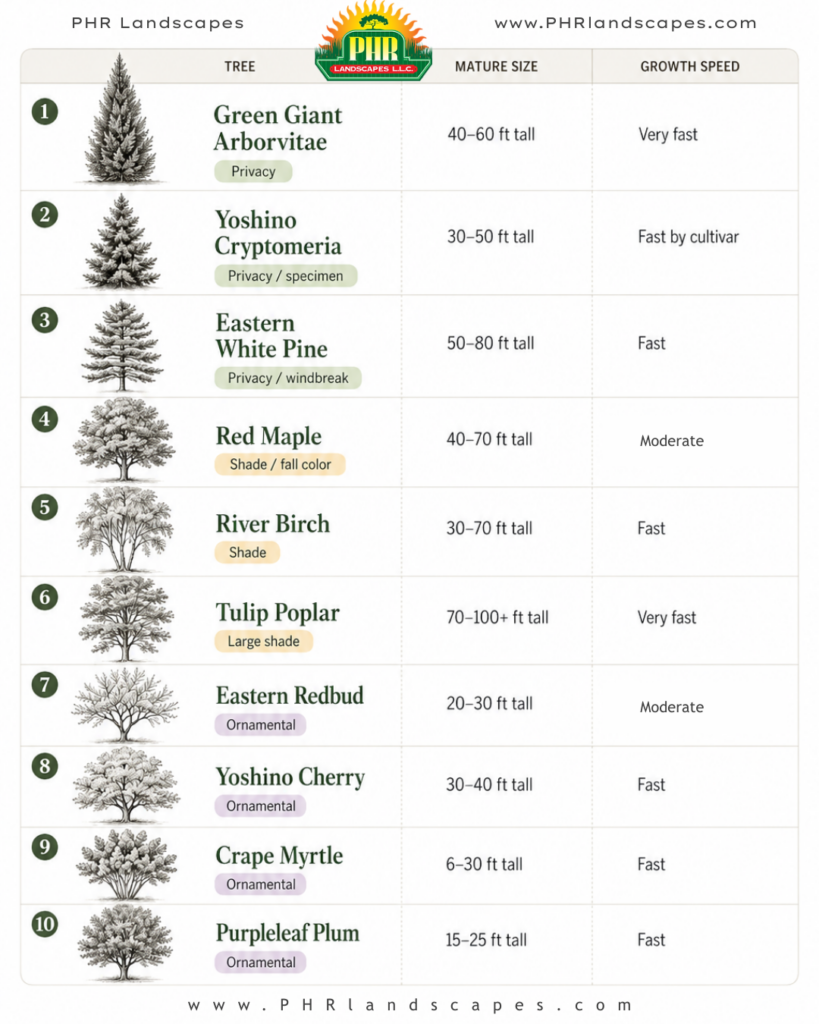
Quick Visual: Fast Growing Trees for New Jersey Homes
Use this quick comparison chart as a simple starting point when choosing the right fast growing tree for your New Jersey yard. Privacy trees like Green Giant Arborvitae, Yoshino Cryptomeria, and Eastern White Pine are best for screening and property borders, while shade trees like Red Maple, River Birch, and Tulip Poplar are better suited for open lawn areas with room to grow. For front yards, patios, and accent beds, ornamental trees like Eastern Redbud, Yoshino Cherry, Crape Myrtle, and Purpleleaf Plum can add seasonal color, structure, and curb appeal without overwhelming the landscape.
Fast Growing Privacy Trees for New Jersey Yards
Privacy trees are some of the most requested plantings in New Jersey landscaping. Whether the goal is blocking a neighboring house, softening a fence line, creating a backyard retreat, or screening a road, evergreen trees are usually the strongest choice because they provide coverage year-round.
The important part is spacing. Many homeowners plant privacy trees too close together because they want instant coverage. That can work for a few years, but overcrowding eventually leads to thinning, disease pressure, poor airflow, and uneven growth. A better privacy planting is usually staggered, layered, and spaced for the mature size of the tree, not just the size it is on installation day.
Green Giant Arborvitae
Latin Name: Thuja standishii x plicata ‘Green Giant’
Origin: Hybrid of Japanese arborvitae and western redcedar
Best Use: Fast evergreen privacy screen
Estimated Growth Rate: Up to 3-4 feet per year in ideal conditions
Mature Size: Approximately 40-60 feet tall and 12-18 feet wide
Time to Useful Privacy: Often 3-5 years, depending on starting size
Time to Maturity: Roughly 15-20+ years in landscape conditions
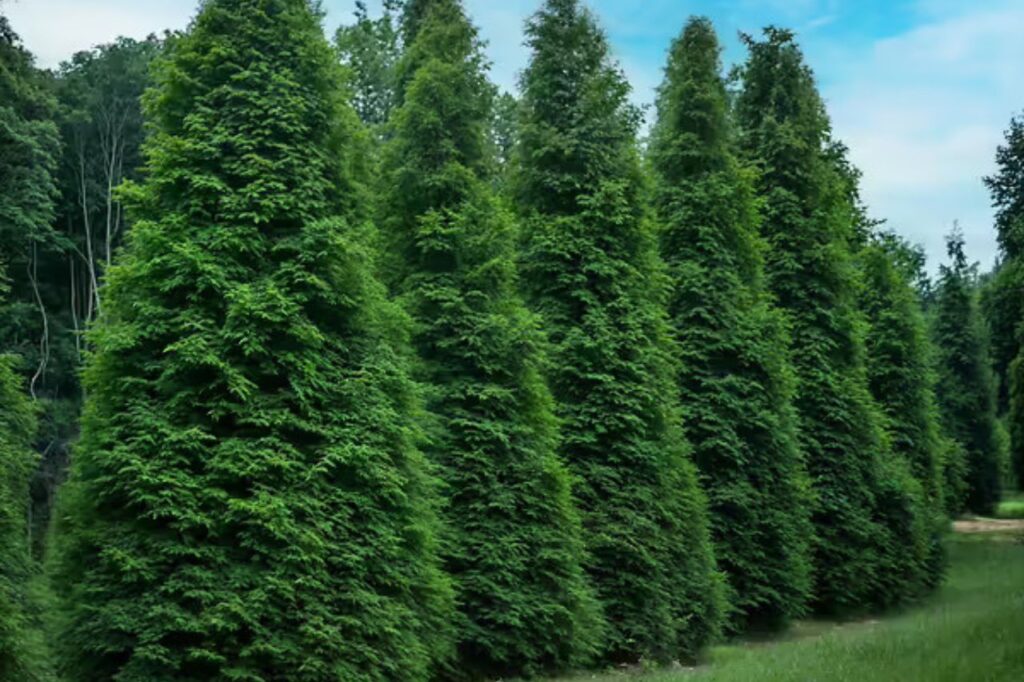
Green Giant Arborvitae is one of the most popular fast growing privacy trees for New Jersey yards because it checks many of the boxes homeowners care about: it grows quickly, stays evergreen, has a dense pyramidal shape, and usually requires very little formal pruning.
For properties in Scotch Plains, Fanwood, and Westfield where homeowners want a tall green privacy wall without building a fence, Green Giants are often a strong option. They work especially well along rear property lines, side yards with enough width, and larger borders where they can be planted in a clean row or staggered double row.
Planting Notes
Green Giant Arborvitae performs best in full sun to part shade and prefers moist, fertile, well-drained soil. It can tolerate a range of soil types, but it does not like constantly wet roots or salty conditions. Avoid planting it in areas where road salt spray, poor drainage, or compacted soil will stress the root system.
For privacy rows, spacing often falls in the 5 – 8 foot range, depending on the desired density, starting tree size, and long-term maintenance plan. For a more natural screen, staggered spacing gives a fuller look and better airflow than a perfectly tight wall.
Care Directions
Water deeply during the first two growing seasons, especially during summer heat. Mulch the root zone with 2 – 3 inches of mulch, keeping mulch pulled back from the trunk. Avoid heavy shearing unless the goal is a formal hedge. Most Green Giants naturally keep an attractive shape with minimal pruning.
Watch for bagworms and root issues in poorly drained soil. A properly placed Green Giant is relatively low maintenance, but a poorly placed one can outgrow its space quickly.
PHR Planting Tip
Green Giant is best for homeowners who want fast privacy and have enough space. It is not the right tree for a narrow 3-foot planting strip between a driveway and fence. Give it room and it becomes one of the best fast growing privacy trees for New Jersey landscapes.
Yoshino Cryptomeria
Latin Name: Cryptomeria japonica ‘Yoshino’
Origin: Japan and southern China; ‘Yoshino’ is a cultivated variety
Best Use: Evergreen privacy, specimen tree, softer screening
Estimated Growth Rate: Fast for selected cultivars under good conditions
Mature Size: Approximately 30-50 feet tall, depending on cultivar and site
Time to Useful Privacy: Often 5-8 years
Time to Maturity: Roughly 20-30 years
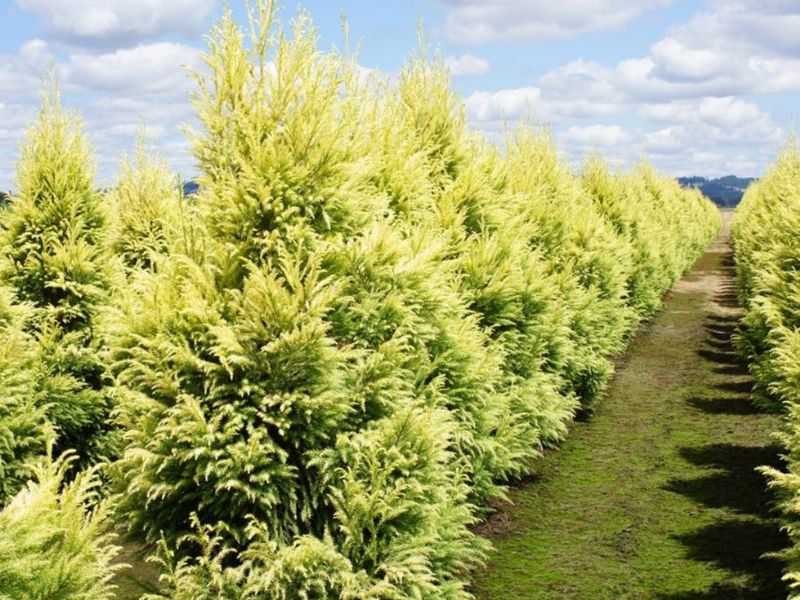
Yoshino Cryptomeria, also called Japanese cedar, is an excellent choice for homeowners who want evergreen privacy but prefer a softer, more textured look than a standard arborvitae row. It has a graceful pyramidal form, fine evergreen foliage, and attractive reddish-brown bark that becomes more noticeable with age.
This tree works well in modern, natural, and woodland-inspired landscape designs. It can be used as a privacy screen, but it also looks strong as a specimen tree where its shape and texture can be appreciated.
Planting Notes
Cryptomeria prefers rich, moist, acidic, well-drained soil. It can handle full sun to partial shade, but it should be protected from harsh winter winds where possible. In New Jersey yards, it is best placed where it gets good light, enough root space, and decent airflow.
For privacy screening, spacing depends on the cultivar and desired density, but Yoshino Cryptomeria generally needs more breathing room than a narrow hedge plant. It should not be jammed tightly against a house, driveway, or fence.
Care Directions
Water consistently during establishment. Mulch around the root zone to conserve moisture and regulate soil temperature. Once established, Cryptomeria is relatively low maintenance, though it may bronze slightly in winter depending on the cultivar and exposure.
Prune lightly if needed, but avoid cutting heavily into old wood. Choose the right cultivar and spacing at installation so the tree can maintain its natural form.
PHR Planting Tip
Cryptomeria is a great “designer privacy tree.” It gives screening, but it also adds texture and movement. For a high-end landscape design in Westfield or Scotch Plains, it can look more custom than a basic wall of evergreens.
Eastern White Pine
Latin Name: Pinus strobus
Origin: Northeastern United States and Canada
Best Use: Large-scale privacy, windbreaks, natural borders
Estimated Growth Rate: Medium-fast to fast; commonly around 2-3 feet per year in good conditions
Mature Size: Approximately 50-80 feet tall and 20-40 feet wide
Time to Useful Privacy: Often 5-8 years
Time to Maturity: Roughly 25-40+ years
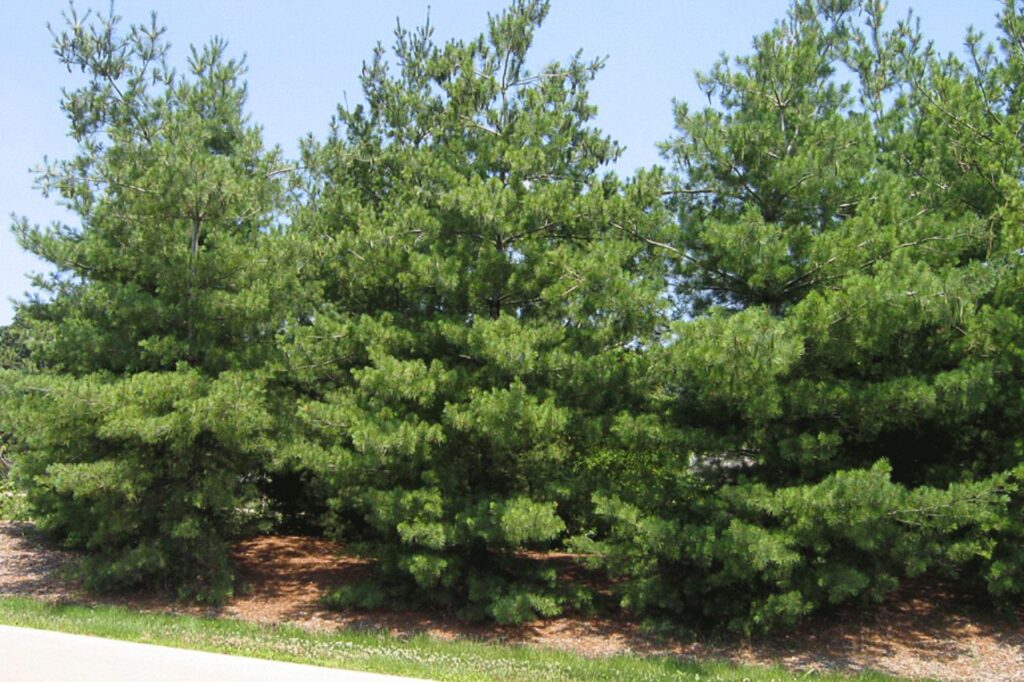
Eastern White Pine is a beautiful native evergreen with long, soft, blue-green needles and a graceful natural shape. It is a strong choice when a homeowner wants a more natural privacy screen rather than a tightly clipped hedge.
This tree is best for larger New Jersey yards, woodland edges, rear property lines, and open areas where it has room to mature. It can create excellent privacy, but it should not be treated like a small ornamental evergreen. Eastern White Pine eventually becomes a large tree.
Planting Notes
Eastern White Pine prefers full sun, cool conditions, and moist, well-drained, acidic soil. It tolerates a range of soil conditions, but it does not love salt, pollution, high pH soils, or heavy compaction.
Give this tree space. It should not be planted directly under power lines, too close to a house, or in a tight suburban strip where its mature width will create future problems.
Care Directions
Water young trees during establishment and during drought periods. Mulch the root zone, but keep mulch away from the trunk. Avoid unnecessary pruning except to remove damaged, crossing, or diseased branches.
Eastern White Pine can be affected by white pine weevil, blister rust, wind damage, and other pest or disease issues. Good spacing, proper site selection, and healthy establishment are the best first steps toward long-term success.
PHR Planting Tip
Eastern White Pine is ideal when the goal is natural screening, not a formal hedge. If you have a larger property edge in Fanwood, Scotch Plains, or Westfield, it can create a soft evergreen backdrop that feels established and native.
Fast Growing Shade Trees for New Jersey Yards
Shade trees are long-term investments. A properly placed shade tree can cool a yard, protect a patio from afternoon sun, improve curb appeal, and create structure in an otherwise open property.
The mistake to avoid is planting a large shade tree too close to the house, driveway, walkway, septic system, or overhead wires. Fast growing shade trees need room. The bigger the canopy will become, the more important placement becomes on day one.
Red Maple
Latin Name: Acer rubrum
Origin: Eastern North America
Best Use: Lawn shade, fall color, street/lawn tree with proper spacing
Estimated Growth Rate: Fairly fast under good conditions
Mature Size: Commonly 40-70 feet tall with a 30-50 foot spread
Time to Useful Shade: Often 8-12 years
Time to Maturity: Roughly 20-30+ years
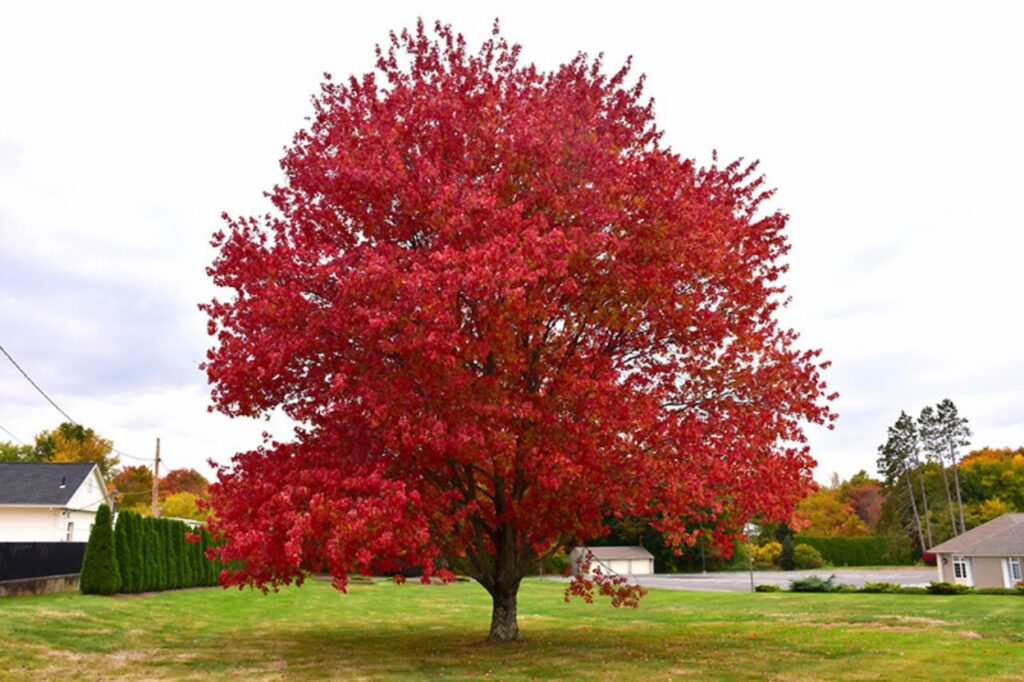
Red Maple is one of the most recognizable native shade trees in the eastern United States. It is loved for its red flowers, red samaras, and red fall color, although fall color can vary by cultivar and site.
For New Jersey homeowners looking for a reliable shade tree with strong seasonal interest, Red Maple is often a good fit. It works well in front lawns, larger side yards, and open backyard spaces where it has enough room to develop a broad canopy.
Planting Notes
Red Maple grows in full sun to partial shade and tolerates a wide range of soils, including clay. It prefers moist, slightly acidic soil and can handle medium to wet conditions. However, it can develop chlorosis in alkaline soils, and its surface roots may compete with grass or nearby plantings.
Avoid planting it too close to sidewalks, driveways, patios, or foundations because mature roots can become an issue.
Care Directions
Water deeply during establishment. Mulch the root zone to reduce mower damage and help retain moisture. Prune young trees for strong branch structure, especially if they are planted in an exposed area.
Watch for surface roots, branch breakage from storms or ice, and common maple pests or diseases. Choosing a strong cultivar and planting it in the right location makes a major difference.
PHR Planting Tip
Red Maple is a strong shade tree for New Jersey yards when homeowners want shade plus fall color. For best results, give it a wide lawn area and avoid trying to force it into a tight planting bed.
River Birch
Latin Name: Betula nigra
Origin: Central and eastern United States
Best Use: Shade, wet areas, rain gardens, winter bark interest
Estimated Growth Rate: Rapid
Mature Size: Approximately 30-70 feet tall and 40-60 feet wide
Time to Useful Shade: Often 7-10 years
Time to Maturity: Roughly 15-25 years
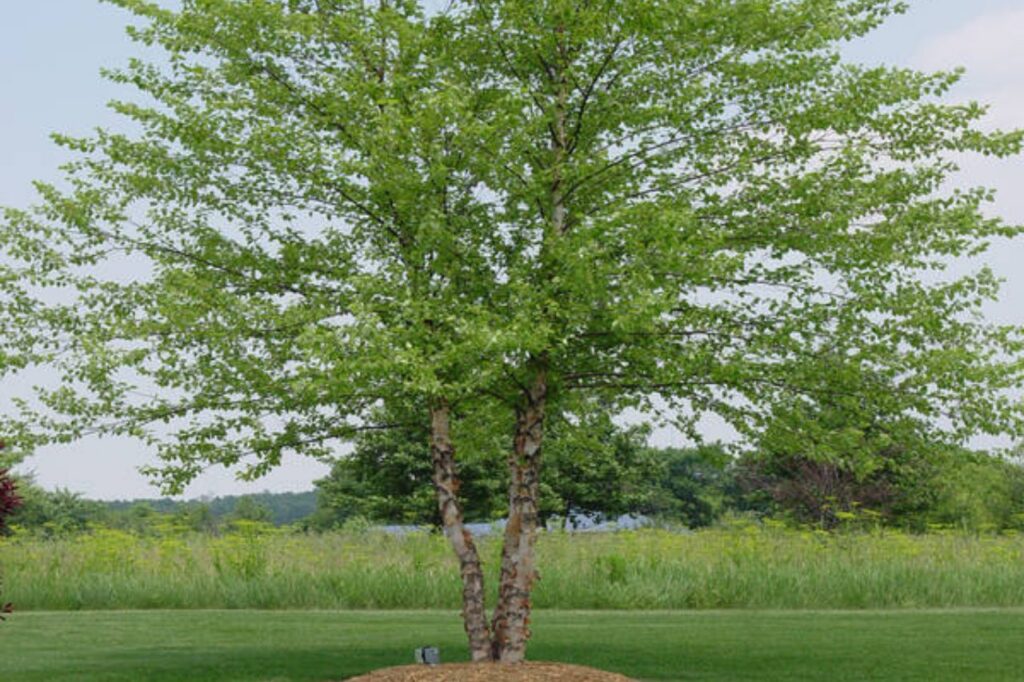
River Birch is one of the best fast growing shade trees for New Jersey yards with moist soil. It is especially useful in areas where other trees struggle because of periodic wetness. Its cinnamon, salmon, tan, or peeling bark creates four-season interest, making it both a shade tree and an ornamental feature.
Many River Birch trees are grown as multi-stem specimens, which gives them a natural, architectural look. They work beautifully near rain gardens, along larger lawn edges, or in naturalized sections of a property.
Planting Notes
River Birch prefers moist, acidic, well-drained soil, but it can tolerate occasional wetness and even periods of flooding. It performs best in full sun to part shade. It is more heat-tolerant than many other birches, which makes it more adaptable for residential landscapes.
Avoid planting River Birch too close to gutters, patios, driveways, or high-maintenance lawn areas because it can drop twigs and shed bark.
Care Directions
Keep the soil consistently moist during establishment. Mulching is especially valuable for River Birch because it helps keep the root zone cool and moist. Avoid pruning in winter or early spring when sap is running; prune during the appropriate dormant window if needed.
River Birch is generally resistant to bronze birch borer compared with other birches, but it can still experience aphids, leaf spot, and stress during drought.
PHR Planting Tip
River Birch is excellent for a yard that needs shade, drainage-friendly planting, and visual character. It is one of the best choices when a homeowner says, “This part of my yard stays a little wet, but I still want something beautiful.”
Tulip Poplar
Latin Name: Liriodendron tulipifera
Origin: Eastern North America
Best Use: Large shade tree, natural areas, large yards
Estimated Growth Rate: Very fast under good conditions
Mature Size: Commonly 70-100+ feet tall in landscapes; can grow larger in ideal forest conditions
Time to Useful Shade: Often 8-12 years
Time to Maturity: Roughly 25-40+ years
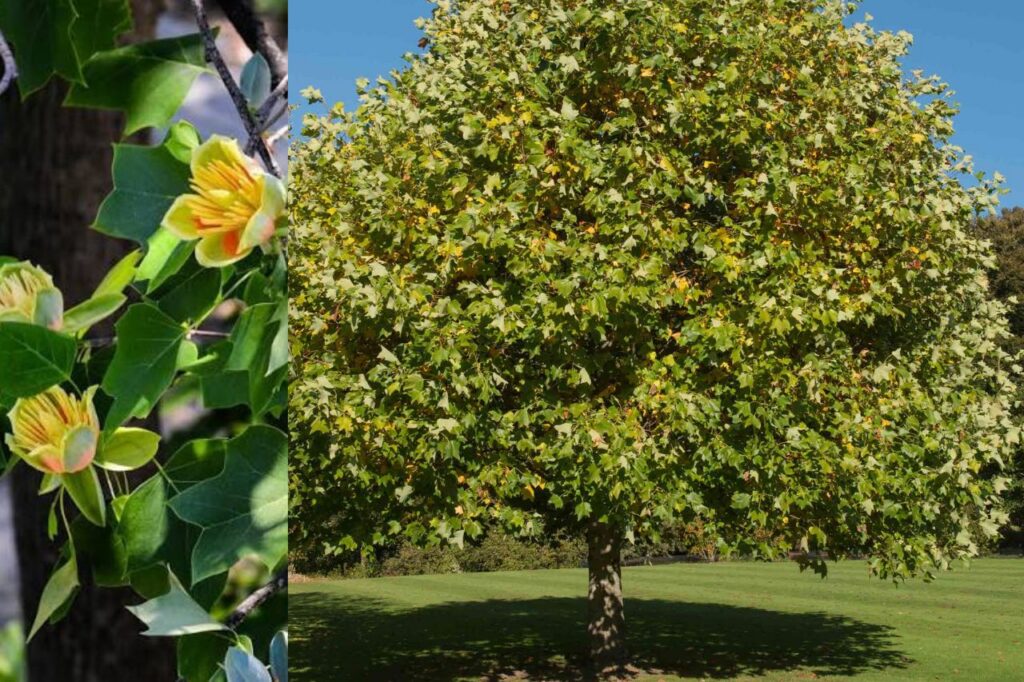
Tulip Poplar, also called Tulip Tree or Yellow Poplar, is one of the fastest growing large native shade trees in the eastern United States. It has distinctive tulip-shaped leaves, yellow fall color, and greenish-yellow flowers with orange markings once mature.
This is a beautiful tree, but it is not for every yard. Tulip Poplar gets big. It needs space, deep soil, and a location where its size will be an asset rather than a future problem.
Planting Notes
Tulip Poplar prefers full sun, deep soil, consistent moisture, and slightly acidic, well-drained conditions. It can be sensitive to drought, compacted soil, and harsh urban stress. It is not ideal for small residential yards or narrow street-tree spaces.
Plant it only where it has room to become a major canopy tree. Avoid planting it near houses, patios, driveways, power lines, or small front yards.
Care Directions
Water consistently during establishment. Protect the trunk from mower and string trimmer damage. Mulch widely around the base, but avoid piling mulch against the trunk.
Because Tulip Poplar grows quickly, it can have weaker wood compared with slower-growing hardwoods. Structural pruning when young can help develop a better form. Monitor for aphids, scale, leaf spots, and storm-damaged limbs.
PHR Planting Tip
Tulip Poplar is best for large properties, open backyards, and naturalized areas. It is not the first recommendation for a tight suburban lot, but in the right space it can become a stunning shade tree.
Fast Growing Beauty and Ornamental Trees for New Jersey Yards
Ornamental trees are usually selected for flowers, foliage color, shape, bark, or seasonal interest. They may not provide the same heavy shade as a large canopy tree, but they often make a stronger visual impact near patios, front yards, walkways, and foundation plantings.
Many ornamental trees are “fast” in a different way than shade trees. They do not always grow 3 – 4 feet per year, but because they mature smaller, they can reach an attractive landscape size much sooner.
Eastern Redbud
Latin Name: Cercis canadensis
Origin: Eastern North America
Best Use: Spring flowers, small-yard focal point, understory planting
Estimated Growth Rate: Moderate to medium-fast when young
Mature Size: Approximately 20-30 feet tall and 20-35 feet wide
Time to Strong Ornamental Impact: Often 3-5 years
Time to Maturity: Roughly 10-15 years
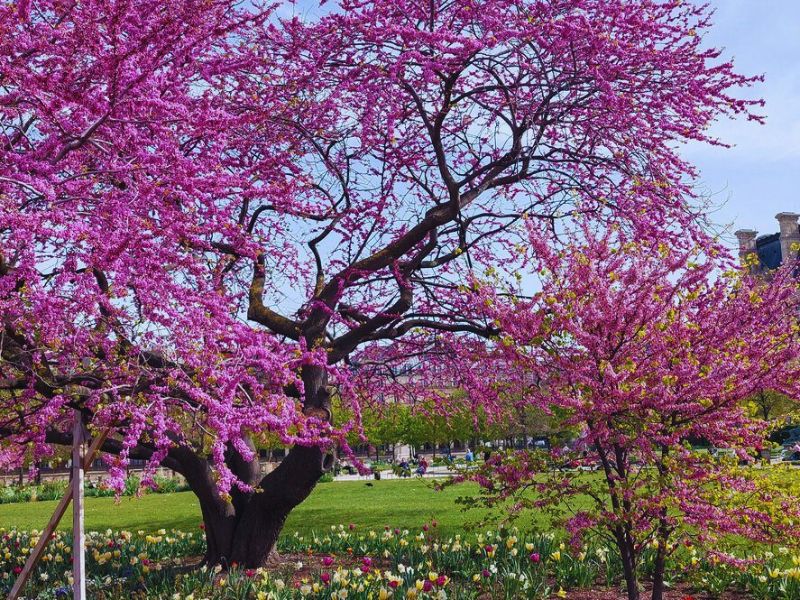
The Eastern Redbud delivers a dramatic early spring flower show before many other plants have fully woken up. Its rose-pink to lavender-pink flowers appear along bare branches, creating a soft, elegant look that works especially well in front yards and woodland-style beds.
This is one of the best ornamental trees for a New Jersey landscape. It has attractive heart-shaped leaves and a natural branching habit that fits well with various layered planting design combinations.
Planting Notes
Eastern Redbud grows in full sun to part shade and can tolerate clay or sandy soil if the site is not too wet. It does best in moderately fertile, well-drained soil. Because it naturally grows as an understory tree, it can perform well near taller trees or in partially shaded garden spaces.
Avoid transplanting it repeatedly. Redbuds do not like root disturbance, so they should be planted carefully in their permanent location.
Care Directions
Water regularly while the tree establishes. Mulch the root zone to protect moisture and reduce competition from turf. Prune dead, damaged, or crossing branches as needed.
Redbud can be sensitive to drought, wet soil, herbicide drift, and branch breakage. Keep it away from areas where lawn chemicals are heavily used.
PHR Planting Tip
Eastern Redbud is a great choice when the goal is front-yard beauty without overwhelming the house. It pairs well with evergreens, ornamental grasses, boxwoods, hydrangeas, hostas, and spring bulbs.
Yoshino Cherry
Latin Name: Prunus x yedoensis
Origin: Japan
Best Use: Spring flowering ornamental tree
Estimated Growth Rate: Rapid
Mature Size: Approximately 30-40 feet tall and 20-50 feet wide
Time to Strong Ornamental Impact: Often 3-5 years
Time to Maturity: Roughly 10-15 years
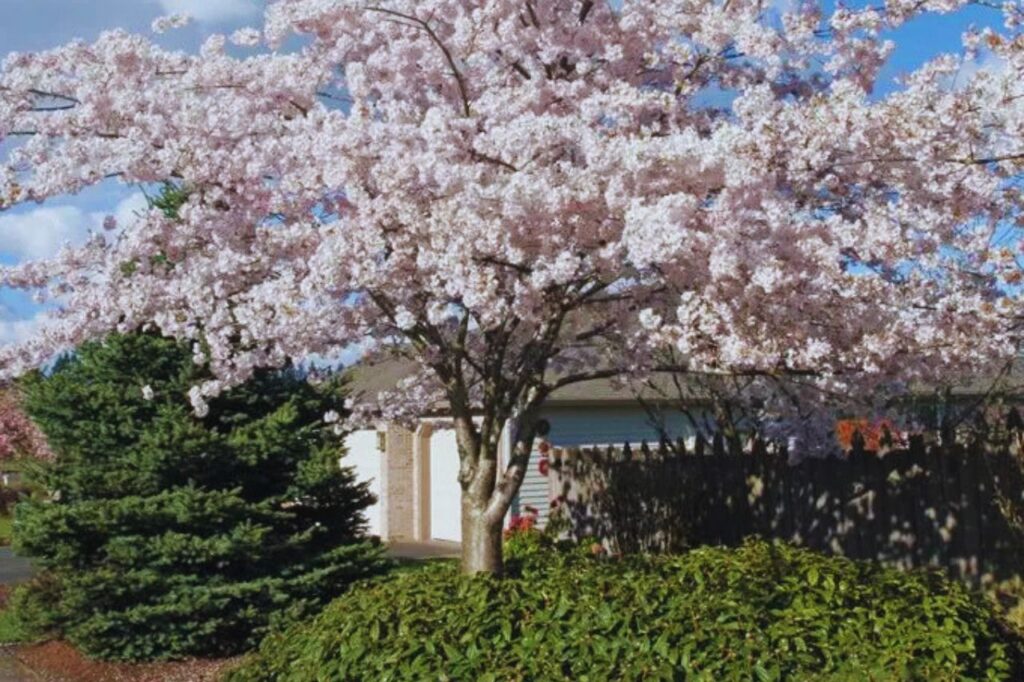
Yoshino Cherry is famous for its clouds of pale pink to white spring flowers. It is one of the most iconic flowering cherry trees and can create a spectacular spring moment in a New Jersey yard.
This tree is best used where its flowers, branching structure, and seasonal presence can be seen and appreciated. It works well as a specimen tree, driveway accent, lawn tree, or part of a larger ornamental planting.
Planting Notes
Yoshino Cherry prefers full sun to part shade and moist, well-drained soil. It can tolerate several soil textures as long as drainage is good. Give it room to spread because the canopy can become wider than expected.
Avoid planting it too close to patios, cars, or walkways where flowers, leaves, or fruit drop may become a nuisance.
Care Directions
Water well during establishment. Mulch the root zone, and avoid damaging the trunk with mowers or trimmers. Prune lightly after flowering or during the correct seasonal window to remove dead or crossing branches.
Flowering cherries can be higher maintenance than some other ornamental trees. Watch for insects, disease issues, branch dieback, and stress from poor drainage.
PHR Planting Tip
Yoshino Cherry is for homeowners who want a true spring showpiece. It is not the lowest-maintenance tree on the list, but when placed correctly, it can be one of the most beautiful ornamental trees in the landscape.
Crape Myrtle
Latin Name: Lagerstroemia indica
Origin: Philippines, Japan, central Himalayas to southern China and Indochina
Best Use: Summer flowers, small ornamental tree, patio or front-yard color
Estimated Growth Rate: Rapid, depending on cultivar and winter conditions
Mature Size: Approximately 6-30 feet tall and wide, depending on variety
Time to Strong Ornamental Impact: Often 2-4 years
Time to Maturity: Roughly 5-10 years, depending on cultivar
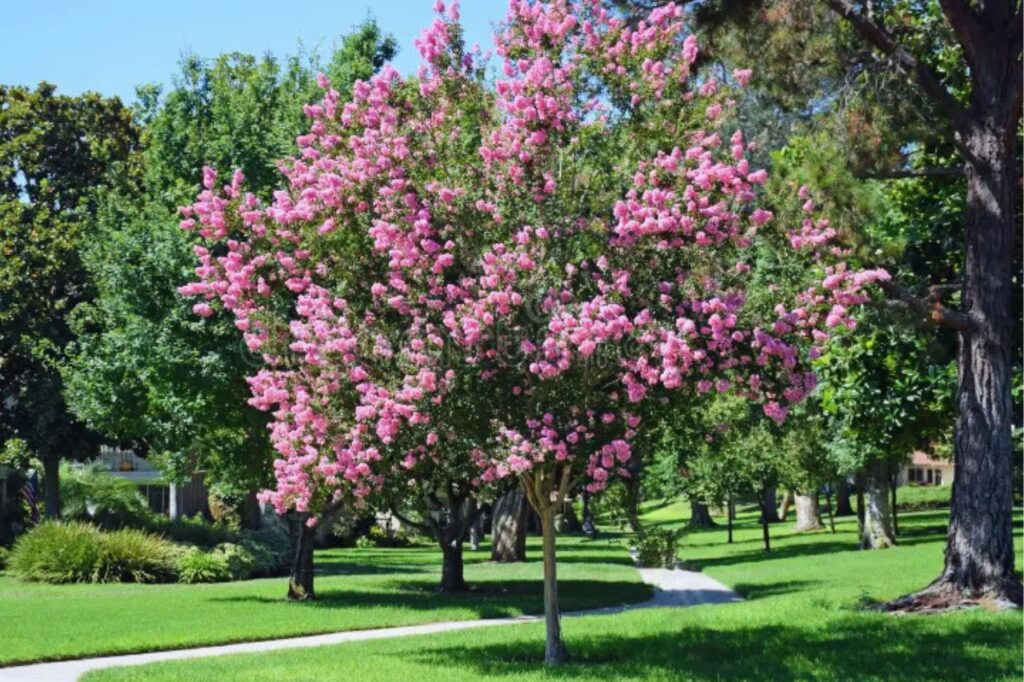
Crape Myrtle brings something different to New Jersey landscapes: long-lasting summer flowers. While many ornamental trees bloom in spring, Crape Myrtle often blooms from mid-summer into late summer, adding color when many other flowering trees are finished.
In Union County landscapes, Crape Myrtle should be selected carefully. Some varieties are more cold-hardy than others, and protected placement matters. In colder or exposed sites, winter dieback may occur, especially on less hardy varieties.
Planting Notes
Crape Myrtle needs full sun to bloom well. It prefers moist, well-drained soil but can tolerate occasional dry conditions once established. For New Jersey yards, choose a hardy cultivar and plant it in a warm, sunny, protected location away from harsh winter wind.
It works well near patios, sunny front yards, pool areas, and mixed ornamental beds.
Care Directions
Water during establishment and drought. Mulch the root zone for moisture and winter protection. Prune in late winter or early spring if needed, because Crape Myrtle blooms on new growth.
Avoid “crape murder,” which is the severe topping of Crape Myrtle. Topping ruins the natural structure and often creates weak, unattractive regrowth. Instead, prune selectively to remove crossing branches, suckers, or dead wood.
PHR Planting Tip
Crape Myrtle is one of the best options for summer color in a sunny New Jersey yard. Use it where it can act as a flowering focal point, not as a foundation shrub crammed under a window.
Purpleleaf Plum
Latin Name: Prunus cerasifera ‘Atropurpurea’
Origin: Parent plant from Asia
Best Use: Purple foliage, spring flowers, small ornamental accent
Estimated Growth Rate: Rapid
Mature Size: Approximately 15-25 feet tall and wide
Time to Strong Ornamental Impact: Often 2-4 years
Time to Maturity: Roughly 8-12 years
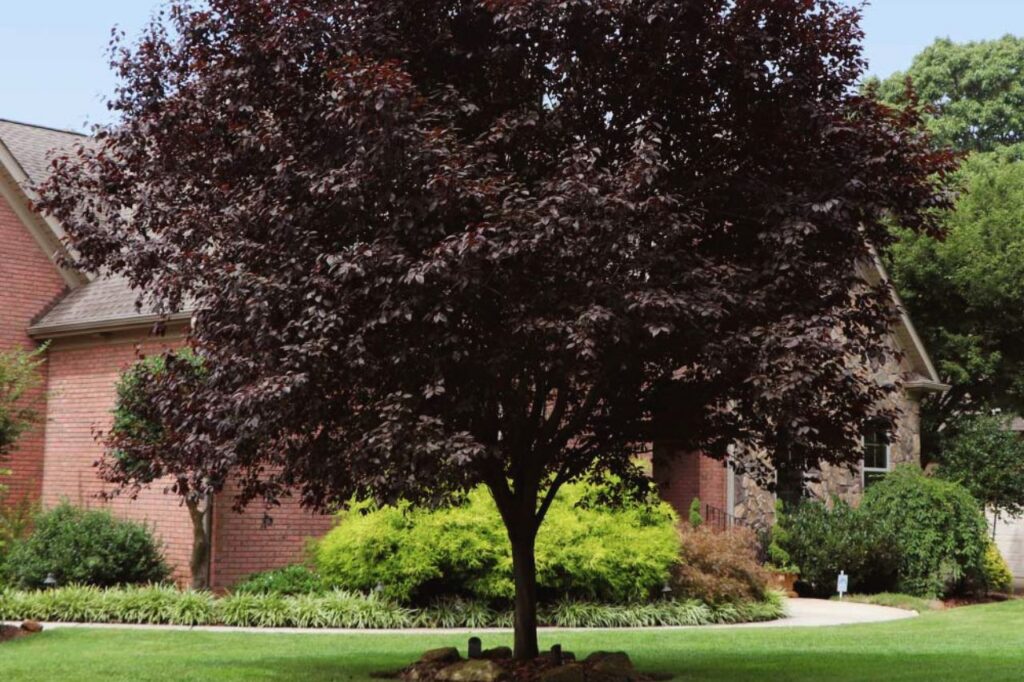
Purpleleaf Plum is a fast growing ornamental tree known for reddish-purple foliage and early spring flowers. It provides bold color contrast in the landscape, especially when planted near green shrubs, grasses, evergreens, or light-colored homes.
This tree is not usually selected for longevity. It is selected for impact. It grows quickly, looks dramatic early, and brings strong color to a landscape design.
Planting Notes
Purpleleaf Plum prefers full sun and moist, well-drained soil. It can tolerate clay, loam, sand, and a range of soil pH conditions. Full sun produces the best foliage color.
Place it where its purple leaves can contrast with surrounding plantings. It works well as a small focal tree, corner accent, front-yard feature, or part of a mixed ornamental bed.
Care Directions
Water during establishment. Mulch to protect the root zone and reduce stress. Prune selectively to improve shape and remove dead or diseased branches.
Purpleleaf Plum can be prone to insect and disease problems and may produce messy fruit. It is best used intentionally as a design feature rather than planted randomly for fast growth alone.
PHR Planting Tip
Purpleleaf Plum is a strong choice when a landscape needs instant color contrast. It is especially effective in front-yard designs where green foundation plants need a bold accent.
Fast Growing Trees: PHR’s Quick Notes
! Trees to AVOID Planting in New Jersey Yards
Some trees may grow fast, but are not a good choice for residential landscapes, the native environment, or a combination and planting should be avoided.
- Bradford / Callery Pear because of invasive behavior, weak branching, and storm breakage
- Silver Maple because of surface roots, weak wood, and infrastructure conflicts
- Willow trees near houses, pipes, or septic systems because of aggressive water-seeking roots
- Leyland Cypress in tight spaces because it can outgrow small yards and develop disease issues
- Tree-of-Heaven because it is invasive and associated with spotted lanternfly issues
Fast growth should never be the only goal. The best tree is the one that grows well, fits the space, and still makes sense 10, 20, and 30 years from now.
What to Consider When Choosing Fast Growing Trees for Your NJ Yard
Fast growing trees can solve many problems, but only when matched to the right location. Before choosing a tree, consider these questions:
1. Do you need privacy, shade, or beauty?
A privacy tree should usually be evergreen. A shade tree needs canopy space. An ornamental tree should be placed where it can be seen and appreciated.
2. How much space do you really have?
A tree that looks small at the nursery may eventually reach 40, 60, or 80 feet tall. Always plan around mature height and width.
3. Is the area sunny or shaded?
Most fast growing trees perform best with at least several hours of direct sun. Flowering trees especially need good sunlight for strong blooms.
4. Is the soil wet, dry, compacted, or well-drained?
River Birch may love a moist area where another tree struggles. Green Giant Arborvitae may fail in constantly wet soil. Red Maple may tolerate clay, but it still needs proper placement.
5. Are there deer?
Deer pressure is a major issue in many New Jersey neighborhoods. Some trees are more resistant than others while in susceptible stages of growth, but no plant is truly deer-proof under heavy pressure.
6. Are there utilities nearby?
Do not plant large shade trees under power lines. Do not plant aggressive-rooted trees next to sidewalks, septic fields, patios, or foundations.
Fast Growing Trees by Goal
Best Fast Growing Privacy Tree
Green Giant Arborvitae is usually the top choice for fast evergreen screening where there is enough space.
Best Native Privacy Tree
Eastern White Pine is excellent for larger naturalized screens and property borders.
Best Fast Growing Shade Tree for Wet Soil
River Birch is one of the strongest choices for moist or periodically wet areas.
Best Large Shade Tree
Tulip Poplar is one of the fastest large shade trees, but only for big spaces.
Best Ornamental Tree for Spring Flowers
Eastern Redbud and Yoshino Cherry are both excellent, depending on the design style.
Best Ornamental Tree for Summer Flowers
Crape Myrtle is a great option for sunny, protected New Jersey yards.
Best Ornamental Tree for Foliage Color
Purpleleaf Plum provides quick purple foliage contrast.
FAQ: Fast Growing Trees in New Jersey
What is the fastest growing privacy tree for New Jersey?
Green Giant Arborvitae is one of the fastest and most popular privacy trees for New Jersey yards. It can grow several feet per year in good conditions and creates dense evergreen coverage.
What is the best fast growing shade tree for NJ?
For many residential yards, Red Maple and River Birch are strong choices. Red Maple provides classic shade and fall color, while River Birch is especially useful for moist areas and winter bark interest.
What fast growing tree should I plant for a small front yard?
Eastern Redbud, Crape Myrtle, Yoshino Cherry, and Purpleleaf Plum can work well in smaller front yards, depending on sunlight, spacing, and design goals.
When is the best time to plant trees in New Jersey?
Spring and fall are generally the best planting seasons for trees in New Jersey. Fall is often excellent because cooler temperatures reduce stress while roots continue to establish.
How often should new trees be watered?
New trees need consistent deep watering during establishment, especially during the first one to two growing seasons. Watering needs depend on rainfall, soil type, tree size, and temperature.
Are fast growing trees weaker than slow growing trees?
Some fast growing trees have weaker wood or shorter lifespans, but not all. The key is choosing quality species, planting them correctly, and pruning young trees for strong structure.
What trees should I avoid planting near my house?
Avoid planting large shade trees too close to foundations, driveways, patios, septic fields, or overhead utilities. Trees like Tulip Poplar, Eastern White Pine, and Red Maple need adequate space to mature safely.
The Better Landscaping Company in Scotch Plains, Fanwood, Westfield & Surrounding areas
Choosing the right tree is only half the equation, proper installation and further care ensures your tree will thrive.
A tree planted too deep, too close to a structure, in compacted soil, or without proper watering can struggle for years. A tree planted correctly, in the right place, with the right surrounding landscape design can become one of the most valuable features on the property.
At PHR Landscapes, we help homeowners in Scotch Plains, Fanwood, Westfield, and surrounding New Jersey towns choose trees that fit their property, goals, and long-term maintenance needs. Whether you want fast growing privacy trees, a new shade tree, a flowering ornamental, or a complete landscape design, we can help create a plan that works now and still makes sense as the landscape matures.
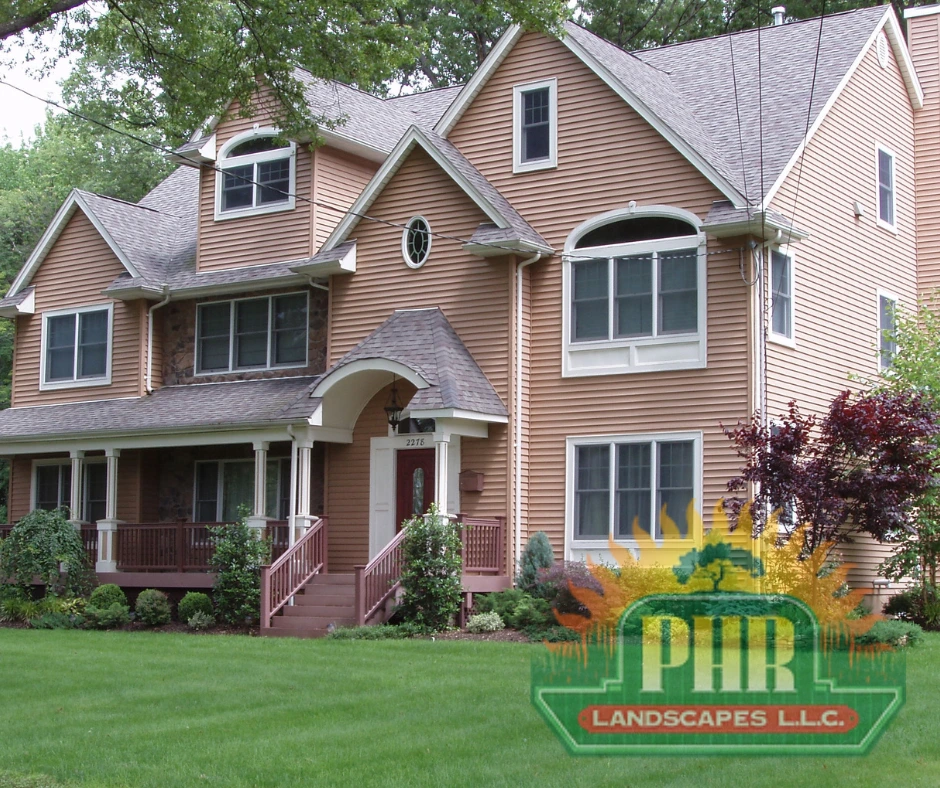
Maintaining a manicured landscape starts with consistent, professional care – and that’s where we come in!
💡 If you’re looking for a dependable, experienced landscaping services in Scotch Plains, Fanwood, Westfield, and Surrounding Areas, we’re here to help.
👉 Call PHR Today to Schedule Your Free Consultation
👉 Landscape Design in Westfield, Fanwood, Scotch Plains and Surrounding Areas
Share This Post with Friends & Colleagues

Follow us on Facebook @PHRLandscapes
Phone: (908) 322-6500
Email: sales@phrlandscapes.com
1590 E. 2nd Street, Scotch Plains, NJ 07076

