

Why Is Water Pooling in My Yard? 7 Possible Causes and Drainage Solutions for NJ Homes
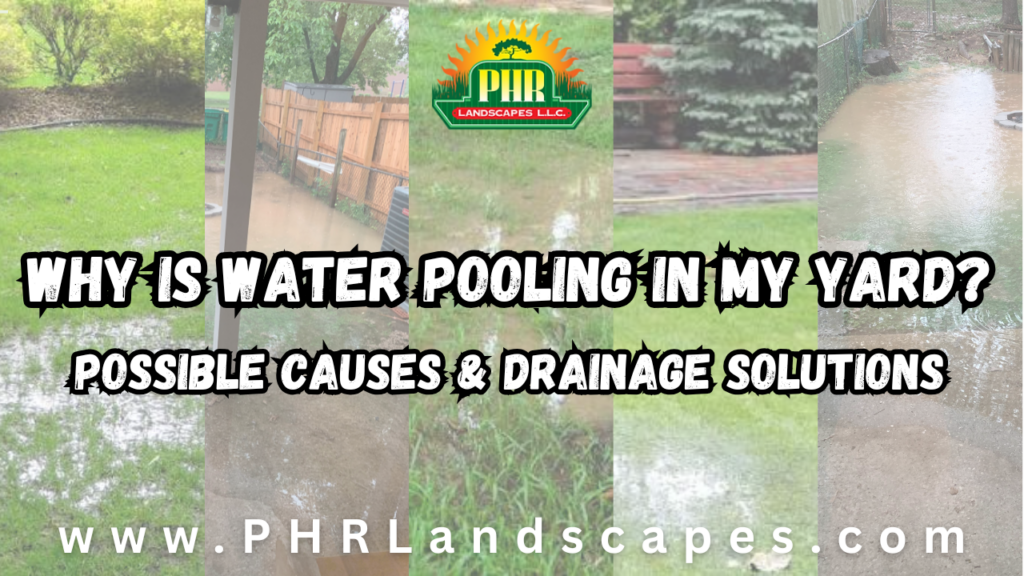
A heavy rain passes through, the sun comes back out, and most of your property begins to dry.
One section of the lawn, however, remains covered in water. Maybe the area turns into mud every time it rains. Perhaps the grass has become thin, mossy, or completely bare. In more serious cases, the water may be moving toward your patio, foundation, basement, or neighboring property.
So, why is water pooling in your yard?
Water usually pools when it reaches a low area faster than the soil can absorb it or the property can safely carry it away. The underlying cause may be improper grading, compacted soil, roof runoff, hardscaping, an obstructed drainage system, or a combination of several problems.
The puddle itself is only the visible symptom. To fix a wet yard correctly, you first need to understand where the water is coming from, why it stops where it does, and where it can safely be redirected.
Is Standing Water After Rain Always a Drainage Problem?
Not every temporary puddle means your property needs a new drainage system.
During an intense storm, rainfall can temporarily exceed the rate at which even healthy soil absorbs water. A brief puddle that disappears as the surrounding property dries may not require major corrective work.
Recurring standing water deserves closer attention when:
- The same areas flood after most storms
- Water remains after the surrounding lawn has dried
- The ground stays soft or muddy for several days
- Grass repeatedly thins or dies in one location
- Mulch, soil, or grass seed washes away
- Water moves toward the house or foundation
- Patios and walkways develop persistent puddles
- The wet area appears even when it has not recently rained
These patterns usually indicate that water is being concentrated, trapped, or prevented from soaking into the soil.
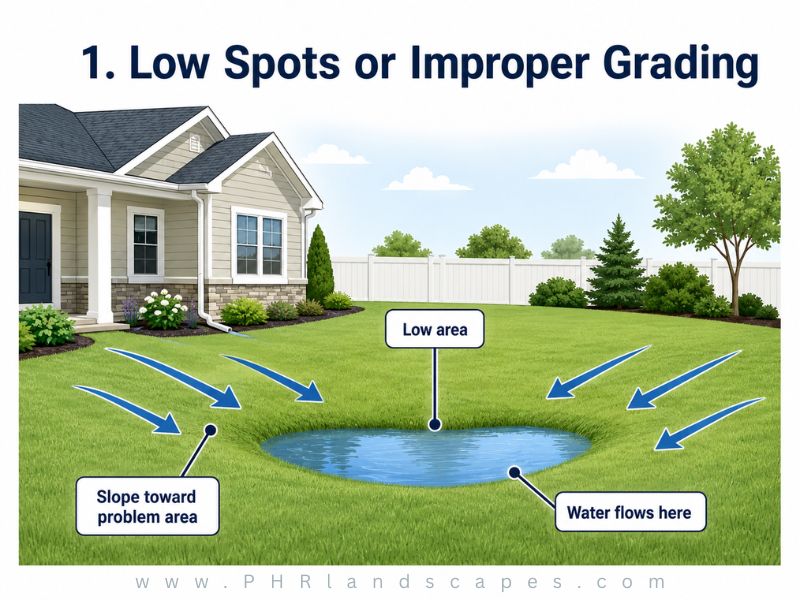
1. High/Low Areas or Improper Grading
Water naturally moves toward the lowest available point.
If part of your yard sits lower than the surrounding lawn, runoff will collect in that depression. This can happen because of the property’s original grade, soil settlement, erosion, construction work, tree removal, or years of repeated foot and equipment traffic.
The grade becomes more concerning when the ground slopes toward the house instead of away from it. Water flowing toward a foundation may contribute to damp basement walls, foundation-area saturation, and repeated pooling beside patios or walkways.
Signs that grading may be the problem
- Water consistently collects in the same visible depression
- The lawn slopes toward the house
- Mulch washes from one bed into another
- Grass seed moves or gathers after rain
- Water travels across the surface instead of soaking in
- A patio, walkway, or addition appears to have interrupted the original slope
Professional grading reshapes the surface so water can move away from structures and problem areas. Rutgers includes site analysis, grading, soil evaluation, and water movement among the central considerations when correcting landscape drainage problems.
Minor depressions can sometimes be corrected by carefully adding and leveling soil. Larger problems may require excavation, regrading, topsoil installation, and lawn restoration.
Simply filling a puddle with topsoil is not always enough. If the water has no appropriate path away from the area, raising one low spot may only push the problem somewhere else.
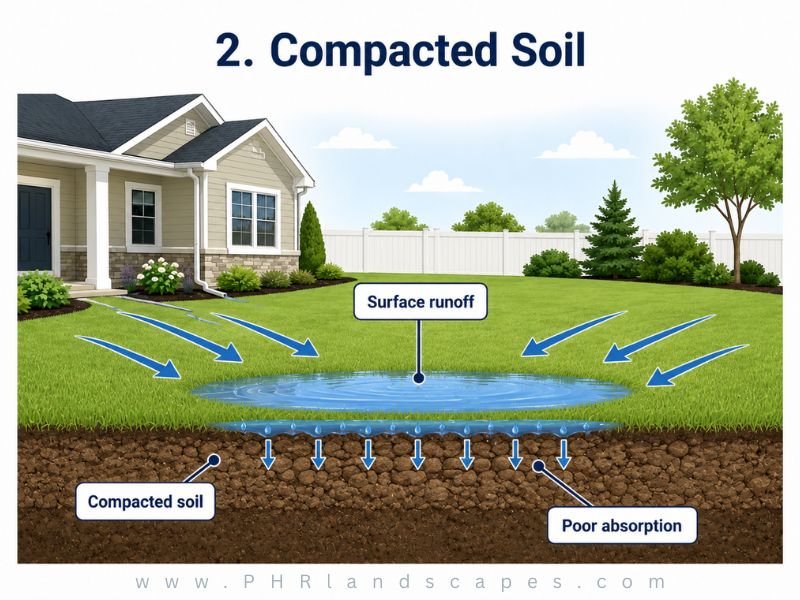
2. Compacted Soil Cannot Absorb Water Properly
Healthy soil contains pore spaces that allow air and water to move through it.
When soil becomes compacted, its particles are pressed closer together. Water then enters the ground more slowly, increasing surface runoff and allowing puddles to form in level areas. Compaction can also restrict oxygen and root growth, making it harder for grass and landscape plants to survive.
Compaction is common in areas exposed to:
- Heavy foot traffic
- Lawn equipment
- Construction vehicles
- Repeated parking
- Play areas
- Poor construction backfill
- Grading performed while the soil was wet
- Walkway shortcuts across the lawn
How to recognize compacted soil
The lawn may feel unusually firm when dry but remain slick or muddy after rain. Grass may grow thin despite seeding and fertilization, and water may move across the surface instead of soaking in.
Surface-level compaction may sometimes improve through core aeration, organic matter, and better traffic management. Severe compaction deeper in the soil profile may require more substantial soil preparation or reconstruction.
Rutgers notes that soil drainage and compaction should be corrected before attempting a major lawn renovation. Otherwise, new seed or sod may temporarily improve the appearance without addressing the reason the original lawn failed.
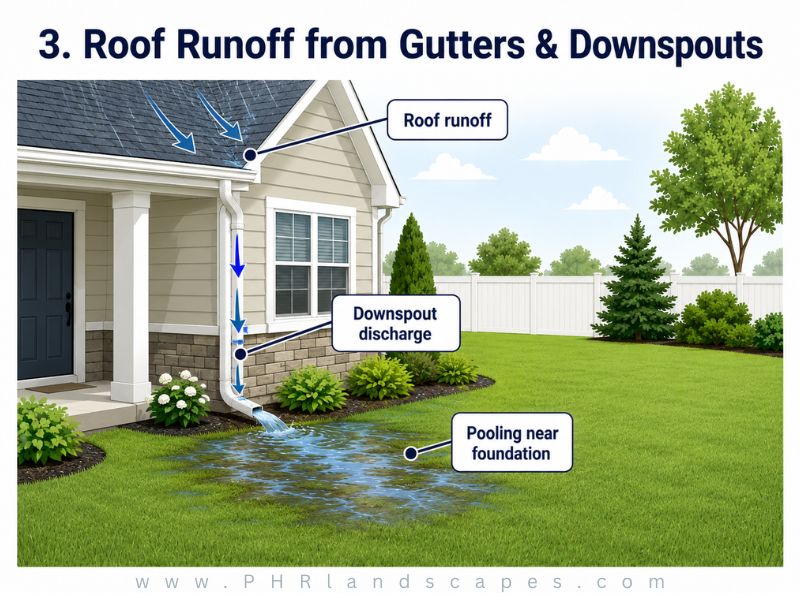
3. Gutters and Downspouts are Concentrating Roof Runoff
A roof collects a significant amount of rainwater and delivers it to a relatively small number of downspouts.
When a downspout ends directly beside the foundation or empties into a flat section of lawn, it can overwhelm the surrounding soil. The result may be erosion, washed-out mulch, basement moisture, or a persistent wet spot beside the house.
Look for these warning signs
- Soil erosion beneath a downspout
- Mulch pushed away from the foundation
- A trench forming through a landscape bed
- Puddles beside the house
- Water entering a basement or crawl space
- Downspout extensions that have disconnected
- Underground downspout pipes that overflow during rain
Rutgers recommends directing downspouts away from foundations while taking care not to discharge roof runoff onto a neighboring property.
Depending on the property, roof runoff may be managed through:
- Properly positioned downspout extensions
- Underground solid drainage pipe
- Catch basins
- Dry wells
- Rain barrels
- Rain gardens
- Carefully designed surface grading
A downspout should not automatically be connected to a perforated French drain. Roof water is generally cleaner and more concentrated than subsurface groundwater, so it is often better transported through a solid pipe to an appropriate destination.
4. Patio, Walkway, Driveway Installation Altered the Water Flow
Patios, walkways, driveways, retaining walls, sheds, additions, and other solid surfaces change how water moves across a property.
Rain that once soaked into open soil may now run across pavers, concrete, or asphalt. If that surface is flat, settled, or pitched in the wrong direction, the runoff may collect on the hardscape or pour into an adjacent section of lawn.
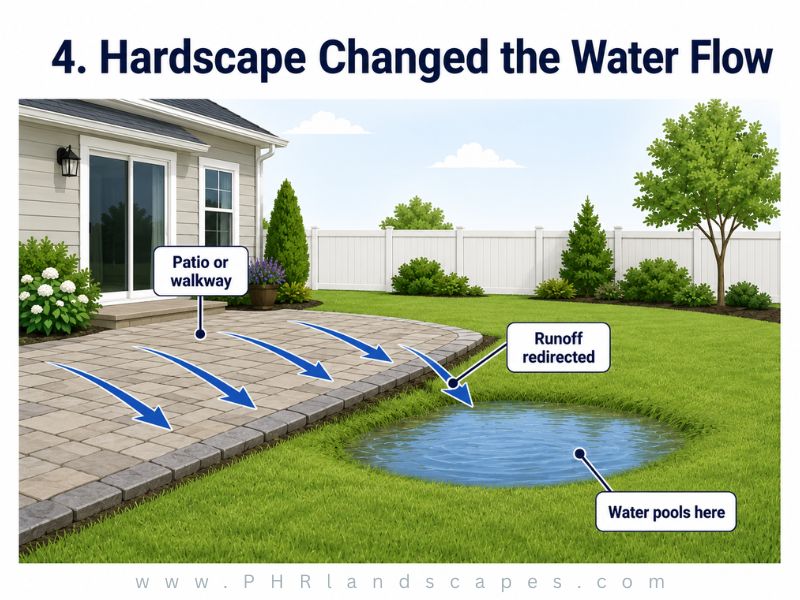
Common hardscape drainage problems include
- A patio pitched toward the house
- Pavers settling and creating shallow bowls
- Water trapped between a patio and retaining wall
- A walkway acting like a dam across the yard
- Driveway runoff entering a landscape bed
- Missing channel drains near doors or steps
- An improperly prepared hardscape base retaining water
- Edging installed higher than the surrounding lawn
Hardscaping should be planned together with grading and drainage – not treated as an isolated surface installation.
Before installing a patio or walkway, the contractor should consider where existing water currently travels, how the new surface will affect runoff, and whether the surrounding lawn needs to be regraded.
When an existing patio repeatedly holds water, the solution may involve resetting settled areas, correcting the pitch, installing a channel drain, adding a catch basin, or rebuilding part of the surrounding grade.
5. Water Flows Downhill From Another Part of the Property
The wettest part of a yard is not always where the drainage problem begins.
Water may originate from:
- An uphill section of the same property
- A neighboring yard
- A sloped driveway
- A roof or detached garage
- A retaining wall
- A higher patio or pool area
- Runoff entering through a fence line
A low backyard may receive water from several surfaces at once. Fixing the visible puddle without controlling the incoming runoff can leave the main problem unchanged.
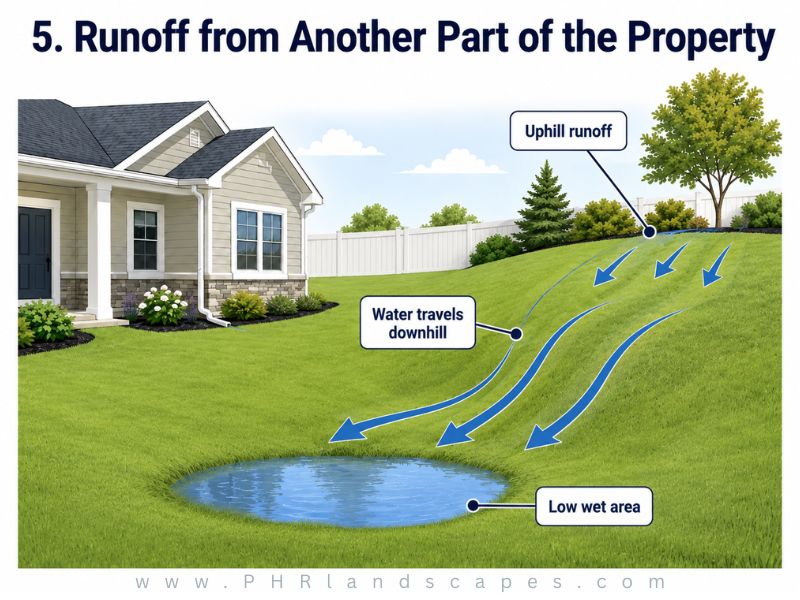
Watch the yard while it is raining
One of the best ways to understand a drainage issue is to observe the property during a moderate storm.
Look for:
- The direction water travels across the lawn
- Areas where two runoff paths meet
- Water entering from beneath a fence
- Overflow from gutters and downspouts
- Mulch or soil moving with the water
- Puddles forming beside retaining walls
- Water becoming trapped behind edging or hardscaping
Depending on the property, incoming surface water may be intercepted through a swale, catch basin, grading adjustment, French drain, planted drainage area, or a combination of systems.
Drainage should always be designed around a safe and appropriate outlet. Redirecting concentrated runoff toward a neighboring property can create a new drainage problem and may conflict with local requirements.
6. Existing Drainage System Is Clogged, Damaged, or Undersized
Some yards already have drainage systems, but those systems do not always continue working as intended.
Underground pipes can become clogged with soil, roots, leaves, and debris. Catch basins may fill with sediment. Corrugated pipe can crush, separate, or lose its original slope. An older drainage system may also be too small to manage runoff from a newer patio, addition, driveway, or roof configuration.
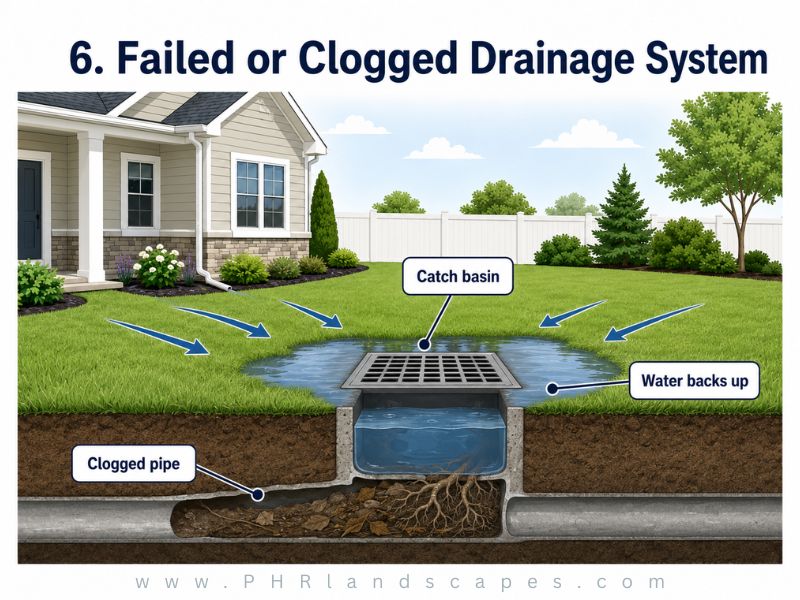
Signs of a failed drainage system
- A catch basin fills but drains very slowly
- Water bubbles from an underground pipe
- Downspouts overflow where they enter the ground
- One section of lawn remains wet along the pipe route
- The system worked previously but has gradually become less effective
- A drain outlet cannot be located
- The outlet is buried, blocked, or positioned too low
- Water backs up during heavy rainfall
Installing more drains is not necessarily the answer.
A drainage system must have adequate capacity, proper pitch, suitable pipe, accessible cleanouts where needed, and a legal place for the water to go. A catch basin without an effective outlet is little more than an underground container.
The existing system should be inspected before new drainage components are added.
7. Irrigation or Underground Water Leak
A drainage problem usually appears during or after rainfall. A leak can create a wet area even during otherwise dry weather.
Potential sources include:
- A damaged irrigation line
- A broken sprinkler head
- A leaking outdoor faucet
- A pool or water-feature leak
- A plumbing supply line
- A damaged underground drainage connection
- A municipal or private water-line issue
The EPA identifies unexplained pooling and large soggy areas as possible signs of irrigation-system leakage.
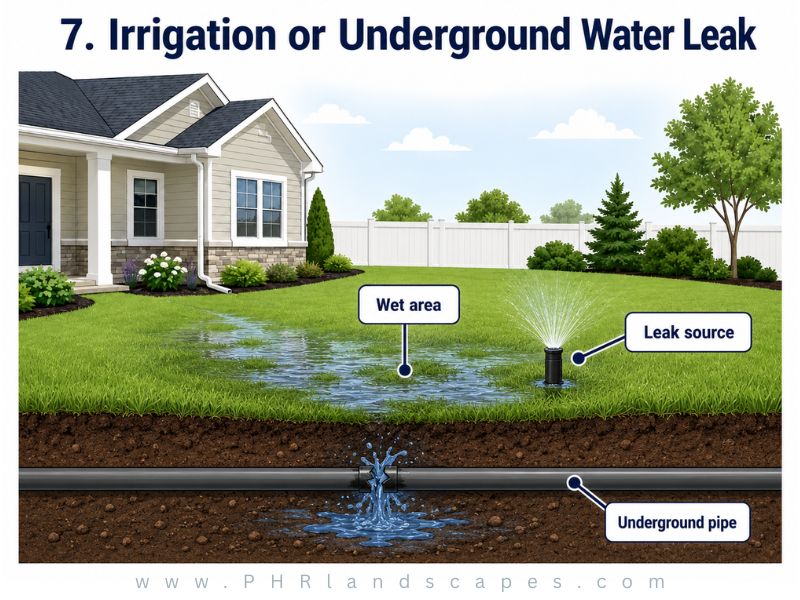
A leak may be more likely when
- The ground stays wet during dry weather
- The water appears clear and continuous
- A sprinkler zone has unusually low pressure
- The wet spot is close to an irrigation head or valve box
- Your water usage increases unexpectedly
- Water rises from one concentrated point
- The area becomes wetter when irrigation is running
A landscaper can evaluate surface grading and landscape drainage, but a suspected water-line or plumbing leak may require an irrigation technician, plumber, utility provider, or pool contractor.
Standing Water = Lawn Damage
Grass roots need moisture, but they also need oxygen.
When soil remains saturated for extended periods, oxygen becomes limited and roots may weaken. Constantly wet soil can also create muddy surfaces, encourage shallow rooting, and make the lawn more vulnerable to damage from foot traffic and equipment.
Repeated pooling may result in:
- Thin or bare grass
- Moss growth
- Muddy play areas
- Soil erosion
- Seed washing away
- Uneven lawn settlement
- Declining shrubs or perennials
- Mosquito habitat in water that remains stagnant
Rutgers identifies improper drainage and soil compaction among the conditions that should be addressed when renovating a struggling lawn.
This is why drainage and grading should often be evaluated before installing expensive sod or repeatedly overseeding the same wet area.
Yard Drainage Solutions: A Brief Overview
There is no single system that fixes every wet yard. The right solution depends on whether the water is moving across the surface, collecting below the surface, entering from a downspout, becoming trapped by hardscaping, or failing to soak into the soil.
Property Grading
Best for:
- Low areas
- Negative slope toward the house
- Uneven lawns
- Surface water moving in the wrong direction
- Preparing a property for seed or sod
Grading uses the shape of the property to guide water toward a safer area.
French Drain
Best for:
- Saturated soil
- Subsurface water
- Wet areas along retaining walls
- Intercepting water moving through a slope
- Recurring moisture below the lawn surface
A French drain typically uses a perforated pipe surrounded by drainage stone to collect water from the surrounding soil.
It is not automatically the best choice for every surface puddle.
Catch Basin (solid drainage pipe)
Best for:
- Concentrated surface runoff
- Low points where water visibly flows
- Patio or driveway runoff
- Downspout discharge
- Areas that receive a sudden volume of water
The basin collects surface water, while a solid pipe transports it to an approved outlet or storage area.
Dry well
Best for:
- Temporarily storing collected runoff
- Managing roof water where soil conditions allow infiltration
- Properties without a convenient surface outlet
- Reducing concentrated discharge at the surface
A dry well must be sized and placed according to the amount of water, soil infiltration, groundwater conditions, and surrounding structures.
Swale
Best for:
- Guiding surface water across a larger area
- Intercepting uphill runoff
- Properties with enough space for a broad, shallow channel
- Creating a natural-looking drainage route
A swale may be planted or maintained as lawn, depending on the design.
Soil correction and aeration
Best for:
- Surface compaction
- Minor infiltration problems
- High-traffic lawn areas
- Lawns with otherwise acceptable grading
Aeration may improve minor compaction, but it will not correct a major low spot, a failed drainage pipe, or a yard that slopes toward the foundation.
How to Diagnose a Wet Yard Before Contacting a Professional
Before deciding that you need a French drain – or any other specific system – take time to understand the full property.
1. Observe the yard during rain
Identify where the water enters, how it travels, and where it stops.
2. Inspect gutters and downspouts
Check for overflow, disconnected extensions, erosion, and blocked underground pipes.
3. Look for visible low points
View the property from several angles. A shallow depression may be difficult to notice when the lawn is dry.
4. Compare wet and dry weather
If the area remains wet without recent rainfall, investigate irrigation or underground leaks.
5. Inspect patios and walkways
Look for settled pavers, incorrect pitch, water trapped by edging, or runoff flowing into the lawn.
6. Evaluate the soil
Hard soil, shallow roots, thin grass, and heavy surface runoff may indicate compaction.
7. Locate the drainage outlet
Every drainage system needs somewhere for the water to go. Confirm that the outlet exists, remains open, and does not create a problem elsewhere.
A professional drainage assessment should evaluate the entire route of the water, not just the location of the puddle.
PHR’s Quick Notes:
Can You Fix Standing Water by Adding Topsoil?
Adding topsoil can help correct a small, shallow depression when the surrounding property already has an appropriate drainage path.
It is less likely to work when:
- The entire yard is improperly graded
- Water is flowing in from uphill
- A downspout is overwhelming the area
- The soil underneath is severely compacted
- Hardscaping is trapping the water
- There is no lower destination for runoff
- The wet spot is caused by a leak
Adding soil without understanding the source may relocate the puddle or direct water toward a patio, fence, planting bed, or neighboring property. This is not recommended unless an extremely minor case.
Will Aeration Fix a Soggy Lawn?
Core aeration may help when shallow soil compaction is slowing water infiltration.
It will not fix:
- A major low spot
- Negative grading
- A broken drainage pipe
- Concentrated downspout runoff
- A high-volume runoff path
- A patio pitched toward the lawn
- A leaking irrigation line
Aeration is a lawn-care technique, not a replacement for a complete drainage plan.
Does Every Wet Yard Need a French Drain?
No. French drains are useful when water is moving through saturated soil or needs to be intercepted below the surface. They are often less effective when the primary problem is a visible low spot, concentrated roof runoff, incorrect hardscape pitch, or surface water that would be better captured by a basin.
The best drainage system matches the way the water is actually moving.
For a detailed comparison of French drains, catch basins, dry wells, grading, and rain gardens, see PHR’s Guide to Yard Drainage Solutions for New Jersey.
When Should You Call a Professional?
Consider scheduling a professional drainage assessment when:
- Water is moving toward the house
- Basement moisture accompanies the yard problem
- The same area floods after ordinary rainfall
- Multiple drainage sources meet in one location
- A large section of lawn remains unusable
- A patio or walkway is settling
- Erosion is exposing roots or washing away soil
- An existing underground system has stopped working
- You cannot identify a safe outlet
- Lawn replacement is being planned for a poorly drained property
More complicated drainage work may also be subject to municipal requirements, especially when work affects stormwater infrastructure, regulated areas, property boundaries, or off-site discharge. New Jersey stormwater rules are implemented in part through state and local review processes, so requirements should be confirmed with the appropriate municipality before work begins.
Yard Drainage and Grading Services in Scotch Plains, Fanwood and Westfield, NJ
A wet yard cannot be corrected reliably by choosing a drainage product first and looking for the cause later.
At PHR Landscapes, we evaluate how water enters the property, how it moves across the lawn, where it becomes trapped, and how the drainage plan will affect the surrounding landscape.
Depending on the property, a complete solution may include:
- Property grading
- Low-area correction
- French drain installation
- Catch basins and underground piping
- Downspout drainage
- Dry wells
- Erosion correction
- Soil preparation
- Lawn renovation
- Patio and walkway drainage
- Landscape restoration after drainage work
PHR Landscapes provides professional drainage, grading, landscaping, lawn renovation, and hardscaping services throughout Scotch Plains, Fanwood, Westfield, and surrounding New Jersey communities.
If water continues to collect in your lawn after rainfall, the next step is not simply deciding which drain to install. It is identifying why the water is there in the first place.
Contact PHR Landscapes today to start planning your property drainage project in: Scotch Plains, Fanwood, Westfield, Clark, Cranford, Berkeley Heights, New Providence, and Surrounding NJ Areas.
Creating a polished outdoor space starts with the right structure, materials, and professional craftsmanship – that’s where we come in!
💡 If you’re looking for a dependable, experienced landscaping services in Scotch Plains, Fanwood, Westfield, and Surrounding Areas, we’re here to help.
👉 Call PHR Today to Schedule Your Free Consultation
👉 Landscaping Services in Scotch Plains, Fanwood, Westfield and Surrounding Areas
Share This Post with Friends & Colleagues

Follow us on Facebook @PHRLandscapes
Phone: (908) 322-6500
Email: sales@phrlandscapes.com
1590 E. 2nd Street, Scotch Plains, NJ 07076
